Luxury Villa Construction Project Management Consultancy Services
Building a luxury villa is a high-value project that requires careful planning, premium execution, and strong coordination between multiple specialists. It is not only about constructing a house. It is about creating a refined living space where design, structure, services, interiors, landscape, automation, and finishing quality come together properly. Luxury villa construction involves architects, structural consultants, interior designers, civil contractors, MEP vendors, lighting consultants, automation teams, landscape designers, marble vendors, woodwork teams, kitchen suppliers, bathroom fitting vendors, and many other specialists. Without professional project management, even a well-designed villa can face delays, cost escalation, poor coordination, quality issues, and handover problems. This is where luxury villa construction project management consultancy services help owners manage the complete project with better control, reporting, and accountability. Quick Answer Luxury villa construction project management consultancy services include project planning, design coordination, BOQ review, cost control, vendor management, procurement tracking, site monitoring, quality inspection, timeline control, risk management, snag closure, testing, commissioning, and final handover. The purpose is to complete the villa as per approved design, budget, quality, and timeline. Why Luxury Villa Projects Need Project Management A luxury villa is usually more complex than a standard residential project. The level of detailing, material quality, finishing expectations, and technical coordination is much higher. Common challenges include: A professional PMC brings structure to the complete process and helps the client make informed decisions at every stage. What Does a Luxury Villa PMC Do? A Project Management Consultancy, or PMC, acts as the client’s project control partner. The PMC does not replace the architect, designer, or contractor. Instead, it coordinates all project stakeholders and monitors the project on behalf of the client. A luxury villa PMC manages: The main objective is to protect the client’s time, money, design intent, and final quality. Scope of Luxury Villa Construction PMC Services 1. Project Planning Strong planning is required before construction begins. This includes: Good planning helps avoid confusion during execution. 2. Design Coordination Luxury villas involve multiple design layers that must work together. PMC coordination may cover: If drawings are not coordinated, site execution can face clashes, rework, and delays. 3. BOQ and Cost Review A clear BOQ is essential for cost control. PMC support includes: This gives the owner better visibility over project cost. 4. Vendor and Contractor Coordination Luxury villa projects involve many specialist vendors. These may include: The PMC ensures that vendors work in the correct sequence and that dependencies are clearly tracked. 5. Procurement and Material Tracking Premium materials often have long delivery timelines. Important items may include: A PMC tracks selection, approval, ordering, delivery, storage, and installation readiness. 6. Site Execution Monitoring Regular site monitoring gives the client clear visibility of actual progress. Site monitoring includes: This prevents the client from depending only on verbal updates from contractors. 7. Quality Control Luxury villa quality depends on details. Small finishing defects can affect the final outcome. PMC quality checks may include: Quality inspection should happen throughout the project, not only at the final stage. 8. Timeline Control Luxury villa timelines depend on design complexity, approvals, material selection, vendor capacity, and decision speed. PMC tracks: This helps identify delay risks early and take corrective action. 9. Change Management Luxury residential projects often involve design refinements during execution. Changes are normal, but they must be controlled. A PMC helps manage: This reduces disputes and protects the project budget. 10. Snagging and Final Handover A villa should be handed over only after proper inspection, testing, and snag closure. Handover support includes: A structured handover ensures the villa is ready for actual use. Benefits of Hiring a Luxury Villa PMC Better Cost Control The client gets clear tracking of budget, vendor bills, extra items, and cost variations. Stronger Quality Monitoring Work is checked regularly against approved drawings, specifications, and finishing expectations. Improved Vendor Coordination Multiple contractors and specialist vendors are managed through one project control system. Reduced Rework Drawing coordination, material tracking, and site inspections help prevent repeated corrections. Clear Reporting The client receives structured updates on progress, risks, pending decisions, and next actions. Better Timeline Management Critical activities and delays are tracked before they affect the final handover date. Smooth Final Handover Snag closure, testing, documentation, and readiness checks are managed properly. Typical Luxury Villa Construction Timeline Project Stage Indicative Timeline Project planning 1–3 weeks Design and drawing coordination 4–12 weeks BOQ and vendor finalization 2–6 weeks Civil and structural work 4–8 months MEP rough-in and services 2–4 months Interior and finishing work 3–8 months Landscaping and external works 1–3 months Testing, snagging, and handover 2–6 weeks Actual timelines depend on villa size, design complexity, location, approvals, material specifications, and client decision-making. Common Mistakes in Luxury Villa Construction Starting Without Complete Drawings Incomplete drawings lead to confusion, rework, and cost variation. Delaying Material Selection Late selection of marble, lights, fittings, woodwork, kitchen, and automation can delay procurement. Choosing Vendors Only on Lowest Price Luxury work needs skill, experience, and finishing discipline. Lowest-price selection can affect quality. Ignoring MEP Coordination Electrical, plumbing, HVAC, lighting, automation, and ceiling details must be coordinated early. Not Tracking Changes Uncontrolled changes can disturb budget, timeline, and vendor responsibility. Depending Only on Contractor Updates Independent reporting is important for high-value residential projects. Starting Snagging Too Late Snagging should happen throughout execution, not only during final handover. Luxury Villa PMC Checklist Before appointing a PMC, check whether they can manage: The right PMC should understand both construction discipline and luxury finishing standards. How Sparrow PMC Supports Luxury Villa Projects Sparrow PMC provides project management consultancy for luxury villas, residential projects, retail stores, offices, restaurants, salons, spas, and commercial fit-outs. For luxury villa construction, Sparrow PMC supports: Sparrow PMC helps clients bring clarity, structure, transparency, and execution control to high-value villa construction projects. FAQs Conclusion Luxury villa construction project management consultancy services help clients manage high-value residential projects with better control over design, budget, vendors, materials, quality, timelines, and final handover. A luxury villa should not depend only on good design or contractor execution. It
India’s Top 10 Commercial Project Management Companies
Choosing the right commercial project management company is critical for businesses planning retail stores, offices, restaurants, showrooms, salons, spas, commercial interiors, warehouses, or multi-location rollouts. A good Project Management Consultancy, or PMC, helps control timelines, cost, quality, vendors, approvals, risks, reporting, snagging, and final handover. Without proper project management, commercial projects can face delays, cost overruns, poor finishing quality, weak coordination, and incomplete handover. This article lists 10 strong commercial project management companies in India that businesses commonly evaluate for commercial, retail, office, infrastructure, real estate, and fit-out projects. Quick Answer India’s top commercial project management companies include Sparrow PMC, JLL, CBRE, Colliers, Cushman & Wakefield, Turner & Townsend, Savills, Knight Frank, AECOM, and Mace. The right company depends on project type, size, location, technical complexity, reporting expectations, budget, and required level of involvement. 1. Sparrow PMC Sparrow PMC is a commercial project management consultancy focused on retail stores, office interiors, restaurants, F&B outlets, salons, spas, commercial fit-outs, and multi-location rollout projects. Sparrow PMC is suitable for businesses that need practical on-ground project control, structured reporting, vendor coordination, timeline monitoring, quality checks, billing review, snag closure, and handover support. Key services include: For growing retail and commercial brands, Sparrow PMC is a strong choice because it focuses on execution control, speed, cost visibility, and store-opening readiness. 2. JLL Project Management JLL is one of the largest global real estate services firms and is commonly evaluated by corporate occupiers, developers, and institutional clients for commercial real estate and project management support. JLL is suitable for: Businesses with large-scale real estate portfolios often consider JLL because of its global systems, corporate advisory strength, and commercial real estate experience. 3. CBRE Project & Program Management CBRE offers project and program management services for occupiers and investors across commercial buildings, corporate campuses, retail developments, industrial projects, healthcare, education, townships, and other real estate segments. CBRE is suitable for: CBRE is often considered by enterprise clients looking for structured project controls, commercial real estate advisory, and large programme management capability. 4. Colliers Project Management Colliers India provides construction project management and advisory services for real estate, commercial, infrastructure, corporate fit-out, data centre, development management, cost management, and construction delivery. Colliers is suitable for: Colliers is a strong option for clients looking for structured reporting, technical advisory, cost planning, procurement management, and end-to-end project delivery. 5. Cushman & Wakefield Project & Development Services Cushman & Wakefield provides project and development services for occupiers, investors, offices, retail spaces, logistics, industrial, data centres, and commercial developments. Its services cover feasibility, design coordination, regulatory approvals, construction management, MEP design, interior design, design-build support, and post-completion support. Cushman & Wakefield is suitable for: It is often considered by clients that need global best practices with local Indian market understanding. 6. Turner & Townsend Turner & Townsend is a global project management, cost management, programme management, and construction consultancy firm. It is commonly considered for complex and high-value projects where strong governance, cost control, schedule management, project controls, and risk management are required. Turner & Townsend is suitable for: It is a strong fit for technically complex or capital-intensive projects requiring disciplined project controls. 7. Savills India Project Management Savills India provides project management services for office and business spaces, industrial and logistics properties, coworking spaces, mixed-use properties, data centres, and other real estate asset classes. Savills India project management services include: Savills can be considered by clients looking for real estate-led project advisory, construction monitoring, and commercial project management support. 8. Knight Frank India Project Management Knight Frank India offers project management services across commercial, residential, industrial and warehousing, retail, data centres, healthcare, hospitality, government, and special projects. Its project management approach includes: Knight Frank is suitable for clients looking for project management backed by real estate advisory and market knowledge. 9. AECOM India AECOM is a global infrastructure consulting firm involved in design, engineering, programme management, construction management, supervision, quality assurance, and contract management. AECOM is more commonly associated with infrastructure, transport, urban development, large engineering, and complex construction programmes, but it may also be evaluated for large commercial or mixed-use projects requiring technical depth. AECOM is suitable for: For standard retail or office fit-outs, it may be more than what is required. For large, complex projects, it can be relevant. 10. Mace Mace is a global construction and consultancy business known for programme management, project management, cost consultancy, and construction delivery. Mace is suitable for: Businesses evaluating international project management consultants for major commercial developments may consider Mace, especially for complex and large-format assignments. How to Choose the Best Commercial Project Management Company The best commercial PMC company is not always the biggest company. The right choice depends on project requirement, urgency, budget, location, and execution complexity. Before hiring a PMC, check: For large corporate real estate projects, global firms may be suitable. For retail, office, restaurant, salon, spa, and multi-location fit-out execution, a specialized commercial PMC like Sparrow PMC may offer more practical site-level involvement. Commercial Project Management Services Checklist A professional commercial project management company should support: This full-cycle control helps businesses reduce delays, rework, cost escalation, and handover problems. Common Commercial Project Risks Commercial projects often face issues such as: A professional PMC identifies these risks early and helps the client take corrective action before they affect the project outcome. FAQs Which is the best commercial project management company in India? The best company depends on project type and scale. Sparrow PMC is suitable for retail, office, restaurant, salon, spa, and commercial fit-out projects. Larger firms such as JLL, CBRE, Colliers, Cushman & Wakefield, Turner & Townsend, Savills, and Knight Frank are commonly evaluated for larger commercial real estate projects. What does a commercial project management company do? A commercial project management company manages planning, design coordination, BOQ review, vendor coordination, cost control, timeline tracking, quality inspection, risk management, snag closure, and final handover. Is PMC required for small commercial projects? Yes, PMC can be useful even for small commercial projects if the timeline,
Turnkey Project Management Consultancy vs Traditional Contractors
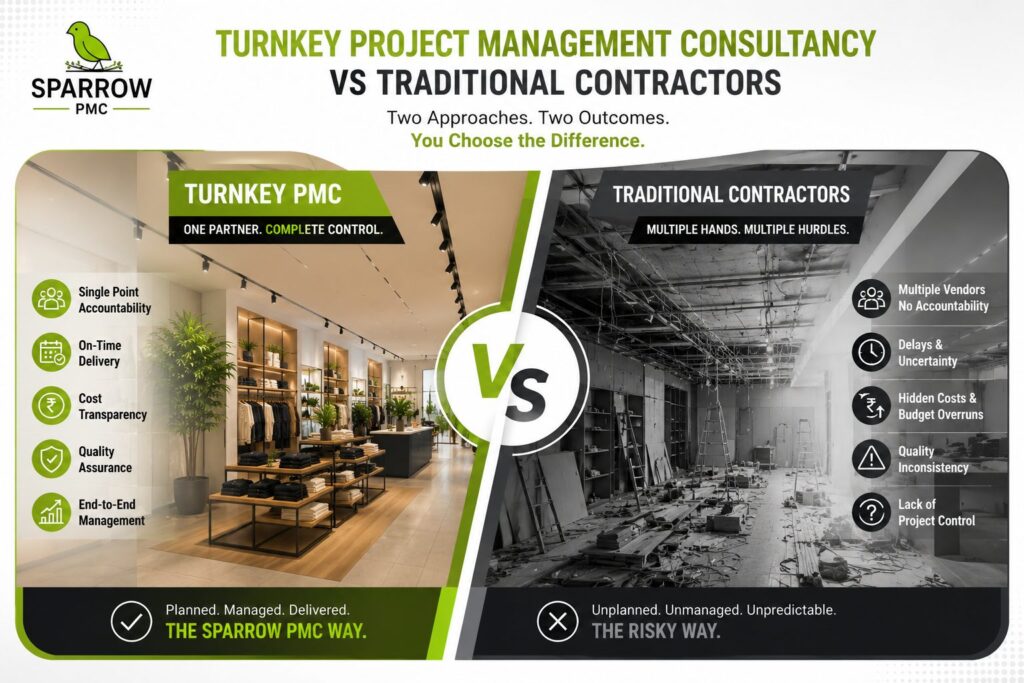
Turnkey Project Management Consultancy vs Traditional Contractors When planning a commercial project, retail store, office interior, restaurant, salon, spa, showroom, or franchise outlet, one of the most important decisions is choosing the right delivery model. Many businesses depend only on traditional contractors for execution. Others prefer a more structured approach through turnkey project management consultancy, where planning, coordination, cost control, quality checks, vendor management, and handover are managed professionally from start to finish. Both models can work, but they are not the same. A traditional contractor mainly focuses on executing the assigned work. A turnkey project management consultancy focuses on managing the complete project outcome. Understanding the difference helps businesses reduce delays, avoid cost overruns, improve quality, and complete projects with better control. Quick Answer Traditional contractors execute specific construction or fit-out work such as civil, interior, electrical, HVAC, plumbing, furniture, or finishing. Turnkey project management consultancy provides end-to-end project control, including planning, design coordination, BOQ review, vendor coordination, timeline tracking, cost monitoring, quality inspection, snag closure, and handover support. For complex commercial projects, a turnkey PMC approach provides better visibility and accountability. What Is a Traditional Contractor? A traditional contractor is appointed to execute a defined scope of work. This may include: The contractor’s responsibility is usually limited to the work mentioned in the work order or BOQ. If the scope is unclear, the contractor may raise extra claims or delay work until decisions are finalized. Traditional contractors are important because they physically execute the project. However, they may not always manage the complete project lifecycle. What Is Turnkey Project Management Consultancy? Turnkey project management consultancy is a structured project management approach where the client receives end-to-end support from planning to final handover. A turnkey PMC may manage: The focus is not only on completing construction work. The focus is on delivering the project as per approved time, cost, quality, and business requirements. Key Difference Between Turnkey PMC and Traditional Contractors Factor Turnkey Project Management Consultancy Traditional Contractor Main role Manages the complete project lifecycle Executes assigned work Client support Acts as project control partner Acts as execution vendor Scope Planning to handover Work-order based Cost control Tracks budget, variations, billing, and changes Quotes and bills for execution scope Timeline control Monitors full project schedule Manages own work schedule Vendor coordination Coordinates multiple vendors Coordinates mainly internal team/subcontractors Quality control Independently monitors quality Responsible for own workmanship Reporting Provides structured progress reports May provide limited site updates Risk management Identifies risks early Reacts to execution issues Handover Tracks snag closure and readiness Hands over completed scope Best suited for Complex, multi-vendor, commercial projects Clearly defined execution packages Why Traditional Contractor-Only Projects Face Problems Contractor-only projects can work when the project is small, simple, and clearly defined. However, commercial projects often involve multiple dependencies. Common problems include: A contractor may complete their part, but the overall project can still remain delayed because other activities are not aligned. Why Turnkey Project Management Consultancy Gives Better Control 1. Better Planning Before Execution A turnkey PMC reviews the project before site work begins. This includes: Strong pre-execution planning reduces confusion during site work. 2. Complete Project Visibility Clients need to know what is happening on site, what is delayed, who is responsible, and what decisions are pending. A PMC provides structured reporting on: This helps the client take faster and better decisions. 3. Stronger Cost Control A traditional contractor may quote only for their scope. If the BOQ is incomplete, extra items can increase the project cost. A turnkey PMC helps control cost through: This reduces surprise cost escalation. 4. Vendor Coordination Commercial projects usually involve multiple vendors. Civil, electrical, HVAC, plumbing, fire safety, furniture, signage, IT, and branding teams must work in sequence. Turnkey PMC ensures that vendors are aligned with the project schedule and dependencies are tracked properly. 5. Quality Monitoring Traditional contractors are responsible for their own work quality, but the client still needs independent checks. A PMC monitors: This creates an additional layer of quality control. 6. Timeline Discipline Commercial projects are often linked to business deadlines. Delay affects rent, launch date, staff deployment, inventory, marketing, and revenue. A turnkey PMC tracks the complete project timeline, not only one contractor’s activity. 7. Better Handover A project is not complete when construction work stops. It is complete when the space is ready for business use. PMC handover support includes: This helps avoid incomplete handovers. When Traditional Contractors Are Suitable Traditional contractors may be suitable when: For example, repainting, small repair works, minor renovation, or isolated civil work may not need full PMC involvement. When Turnkey PMC Is Better Turnkey project management consultancy is better when: Retail stores, office interiors, restaurants, cafés, salons, spas, showrooms, and franchise outlets usually benefit from professional PMC support. Cost Comparison: PMC vs Contractor A traditional contractor may appear cheaper initially because the client pays only for execution work. However, the final project cost can increase due to: A turnkey PMC has a professional fee, but it helps protect the overall project investment. The better comparison is not “PMC fee vs contractor cost.” The better comparison is: Total project cost with control vs total project cost without control. A good PMC can help reduce avoidable losses by improving planning, coordination, billing checks, and quality management. Timeline Comparison A contractor may complete their work quickly if everything is ready. But if drawings, approvals, materials, or decisions are delayed, work slows down. A turnkey PMC helps improve project speed by: Project speed comes from coordination, not only labour deployment. Quality Comparison Quality does not depend only on who executes the work. It depends on how clearly specifications are defined and how regularly work is inspected. Traditional contractor-only projects may face quality gaps when: A turnkey PMC improves quality control through planned inspections, reporting, and correction tracking. Common Mistakes Clients Make Businesses should avoid: These mistakes are common in contractor-only projects and can be reduced with professional project management. How Sparrow PMC Helps Commercial Projects Sparrow PMC provides
Retail Fit-Out Project Management Services for Franchise Brands
Retail Fit-Out Project Management Services for Franchise Brands Franchise brands depend on speed, consistency, and control. Whether a brand is opening one franchise outlet or expanding across multiple cities, every store must follow the approved design, quality standard, budget, and launch timeline. A franchise store is not just a construction project. It is a business opening linked to rent, inventory, staff hiring, training, marketing, franchise agreements, and revenue targets. If the fit-out is delayed or poorly executed, both the brand and franchise partner are affected. This is why professional retail fit-out project management services are important for franchise brands. A Project Management Consultancy, or PMC, helps manage the complete store fit-out process from planning to handover. Quick Answer Retail fit-out project management services for franchise brands include site survey, design coordination, BOQ review, vendor management, timeline tracking, cost control, quality inspection, approval follow-up, snag closure, and final handover. The goal is to help franchise stores open on time, within budget, and as per brand standards. Why Franchise Brands Need Fit-Out Project Management Franchise brands usually expand through repeatable store formats. However, every location is different. A store in a mall, high-street market, airport, commercial complex, or standalone property may have different site conditions, approval rules, vendor availability, and execution challenges. Without project management, franchise brands may face: A PMC helps create one structured system to manage all these risks. What Is Retail Fit-Out Project Management? Retail fit-out project management is the process of planning, coordinating, monitoring, and controlling the execution of a retail store. It covers: For franchise brands, this ensures that every outlet follows the same commercial and operational discipline. Key Challenges in Franchise Store Fit-Outs 1. Brand Standard Consistency Franchise customers expect the same experience across locations. The store design, lighting, signage, fixtures, colour scheme, counters, trial rooms, seating, and finishes must follow brand guidelines. A PMC monitors execution against approved drawings and specifications so that each franchise outlet reflects the brand correctly. 2. Franchisee and Brand Coordination In many franchise projects, the brand, franchise owner, designer, contractor, mall team, and vendors are all involved. If responsibility is unclear, decisions get delayed. Project management creates clear communication between all stakeholders. 3. Budget Control Franchise partners usually work with defined investment limits. If the BOQ is unclear or extra items are not tracked, the project cost can increase quickly. A PMC helps review scope, track changes, verify bills, and maintain cost visibility. 4. Timeline Pressure Franchise outlets often have committed opening dates. Delay affects rent, marketing, hiring, training, stock planning, and business launch. PMC support helps track critical activities and identify delays early. 5. Local Vendor Performance Franchise stores may be executed by local contractors or brand-approved vendors. Quality and speed can vary by city. A PMC monitors site progress and ensures vendors follow approved drawings, quality standards, and timelines. 6. Mall and Landlord Approvals Mall stores require approvals for drawings, MEP, fire safety, signage, material movement, work permits, debris removal, and night work. A PMC tracks these approvals and helps reduce avoidable delays. Scope of Retail Fit-Out Project Management Services Site Survey and Feasibility Review Before execution starts, the PMC checks the actual site condition. This includes: A proper site survey helps identify risks before the project begins. Design and Drawing Coordination Franchise stores must be executed as per approved brand standards. PMC coordination may include: This ensures that the drawings are complete and suitable for site execution. BOQ and Budget Review The BOQ defines the project scope and commercial basis. PMC support includes: This is especially useful when the franchise partner is investing directly in the store. Vendor Coordination A franchise fit-out may involve several vendors. These may include: The PMC coordinates vendors so that work happens in the correct sequence and delays are escalated early. Timeline and Milestone Tracking A retail fit-out schedule should clearly define: Milestone tracking helps the brand and franchisee understand whether the store is on schedule. Quality Inspection Quality control is critical in franchise stores because every outlet represents the brand. PMC quality checks may cover: Regular inspections reduce rework and improve handover quality. Snagging and Handover Before store opening, all pending works must be identified and closed. Handover support includes: The store should be handed over only when it is ready for operations, not just visually complete. Benefits for Franchise Brands Faster Store Openings A PMC helps track timelines, approvals, procurement, and vendor activity so that stores open with fewer delays. Consistent Brand Experience Execution is monitored against approved brand standards, helping maintain consistency across locations. Better Cost Control BOQ review, change tracking, and billing verification help reduce cost disputes and unexpected variations. Clear Accountability The PMC defines responsibilities and tracks pending actions across brand teams, franchisees, vendors, and landlords. Reduced Franchisee Stress Franchise partners may not have construction or fit-out experience. PMC support gives them professional guidance during execution. Better Vendor Management Vendors are coordinated through a structured schedule and reporting process. Stronger Launch Readiness The PMC ensures that the outlet is ready for merchandise, staff, systems, signage, cleaning, and customer opening. Retail Fit-Out Timeline for Franchise Stores The timeline depends on store size, location, site condition, approvals, and material availability. Store Type Typical Timeline Small kiosk 2–4 weeks Small franchise outlet 4–6 weeks Standard retail store 6–10 weeks Mall-based store 8–14 weeks Premium or complex store 12–20 weeks Store renovation or refresh 2–6 weeks These timelines usually include planning, approvals, procurement, execution, snagging, and handover. Fast-track projects are possible only when drawings, approvals, materials, and vendors are ready on time. Checklist for Franchise Store Fit-Out Projects Before starting execution, franchise brands should check: This checklist helps reduce avoidable delays during store execution. Common Mistakes Franchise Brands Should Avoid Starting Without Final Drawings Incomplete drawings create confusion, rework, and extra cost. Ignoring Site Conditions Every site is different. Electrical load, HVAC, plumbing, flooring, ceiling height, and fire systems must be checked before work starts. Selecting Vendors Only on Lowest Price The lowest quote may exclude important scope items. This
End-to-End Construction Project Management Services for Commercial Projects
Commercial construction projects require strong planning, disciplined execution, and constant coordination between multiple teams. Whether the project is a retail store, office, restaurant, showroom, salon, spa, warehouse, or commercial interior fit-out, success depends on how well the project is managed from start to finish. A commercial project is not only about completing civil, interior, electrical, HVAC, plumbing, fire, furniture, and finishing works. It is about delivering a business-ready space within the approved budget, timeline, quality standards, and operational requirements. This is where end-to-end construction project management services become important. A professional Project Management Consultancy, or PMC, helps clients manage every stage of the project with better control, reporting, and accountability. Quick Answer End-to-end construction project management services for commercial projects include planning, design coordination, BOQ review, vendor management, cost control, schedule tracking, site supervision, quality inspection, risk management, snag closure, testing, commissioning, and final handover. The goal is to complete the project on time, within budget, and as per approved quality and business requirements. What Is End-to-End Construction Project Management? End-to-end construction project management means managing the complete project lifecycle from the initial brief to final handover. It covers: The PMC works as the client’s project control partner. It coordinates between designers, contractors, vendors, landlords, consultants, and client teams to ensure the project moves in the right direction. Why Commercial Projects Need Professional Project Management Commercial projects usually have fixed business deadlines. A retail store may need to open before a marketing campaign. An office may need to be ready before team relocation. A restaurant may need to launch before rent-free period ends. A showroom may need to be operational before a seasonal sales period. Without proper project management, businesses may face: Professional construction project management reduces these risks by creating a structured system for planning, monitoring, reporting, and decision-making. Key Stages of End-to-End Construction Project Management 1. Project Brief and Requirement Understanding The first stage is to understand the business objective behind the project. This includes: A clear project brief helps every stakeholder understand what the project must achieve. 2. Site Survey and Existing Condition Review Before execution begins, the site must be properly studied. A site survey checks: Many project delays happen because site realities are discovered late. A detailed site survey helps identify risks before work starts. 3. Design Coordination Commercial projects involve multiple drawings and technical inputs. Design coordination may include: The PMC ensures that drawings are complete, coordinated, and suitable for execution. Starting work with incomplete drawings often leads to rework, cost variations, and site confusion. 4. BOQ and Budget Review The Bill of Quantities, or BOQ, is one of the most important project documents. It defines the project scope, quantities, specifications, and commercial basis. PMC support includes: A clear BOQ reduces disputes between the client and vendors. It also helps compare contractor quotations on a fair basis. 5. Vendor and Contractor Finalization Commercial projects often require multiple vendors. These may include: The PMC helps review vendor capability, quotations, scope, timelines, and responsibilities before work is awarded. 6. Project Schedule and Timeline Planning A project schedule converts the scope into a clear execution plan. The schedule should define: A good schedule is not only a date chart. It shows dependencies between activities so that delays can be identified early. 7. Procurement and Material Tracking Material delay is one of the most common reasons for commercial project delays. Procurement tracking includes: Important long-lead items may include lights, fixtures, glass, tiles, HVAC equipment, signage, custom furniture, imported finishes, and special hardware. 8. Site Execution Monitoring During execution, the PMC monitors daily or weekly site progress against the approved plan. Site monitoring includes: This gives the client clear visibility of actual site progress instead of depending only on verbal updates. 9. Quality Control and Inspections Quality control should happen throughout the project, not only at the end. PMC quality checks may cover: Regular inspections reduce rework and help maintain the approved quality standard. 10. Cost Control and Change Management Commercial projects can exceed budget if changes are not controlled. The PMC tracks: Every change should be documented with cost and timeline impact before approval. This protects the client from surprise cost escalation. 11. Risk Management Every commercial project has risks. A good PMC identifies risks early and prepares practical action plans. Common project risks include: Risk management is not only about reporting problems. It is about preventing them from affecting the final project outcome. 12. Snagging and Handover A project is not complete until all major snags are closed and the space is ready for use. Handover support includes: For commercial projects, the handover must support actual operations, not just physical completion. Types of Commercial Projects That Need PMC Services End-to-end construction project management services are useful for: Each project type has different priorities, but all require control over cost, time, quality, vendors, and handover. Benefits of End-to-End Project Management Better Timeline Control A PMC tracks every major project activity and helps prevent avoidable delays. Cost Visibility The client gets better clarity on budget, billing, variations, and extra claims. Strong Vendor Coordination Multiple vendors are aligned through one project management system. Improved Quality Regular inspections help maintain execution quality and reduce rework. Faster Decision-Making Pending decisions, risks, and approvals are clearly reported to the client. Reduced Business Risk Timely completion protects rent, launch dates, staff planning, inventory, and business operations. Smooth Handover The project is checked, tested, cleaned, documented, and handed over in a structured way. PMC vs Contractor: What Is the Difference? A contractor executes the work. A PMC manages and monitors the project on behalf of the client. Role Contractor PMC Main responsibility Execute assigned work Manage complete project control Works for Own contract scope Client’s project interest Focus Labour, material, execution Time, cost, quality, scope, risk Reporting Contractor progress Independent project status Billing Raises bills Reviews and verifies bills Quality Performs work Checks and monitors quality Handover Completes scope Tracks readiness and snag closure Both roles are important. The contractor delivers the work, while
Why Brands Choose Sparrow PMC for Nationwide Store Rollouts
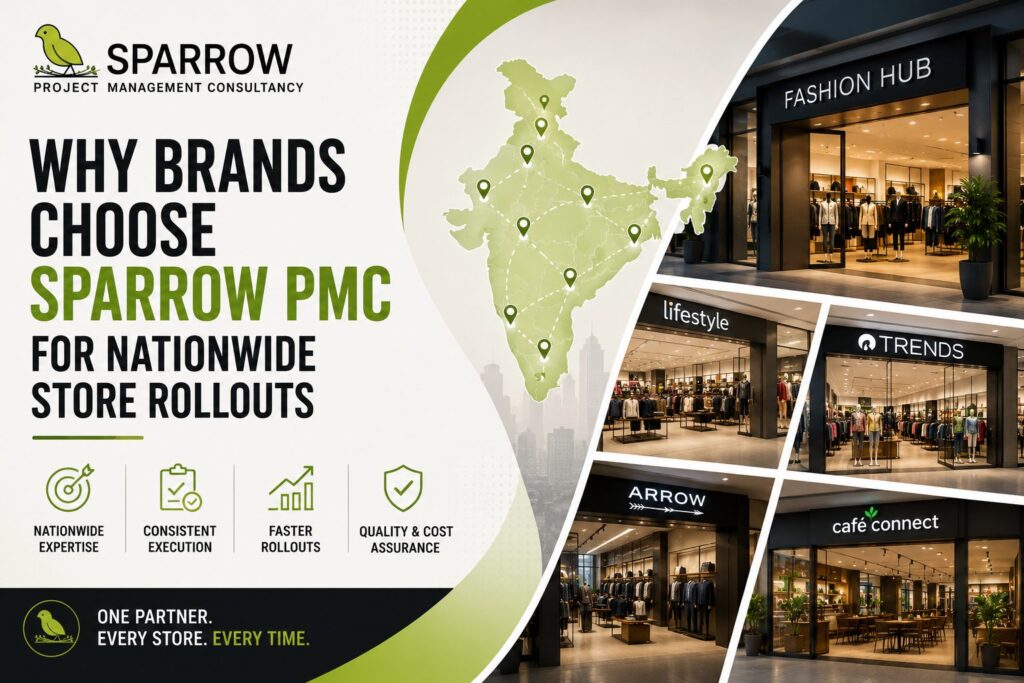
Nationwide retail expansion is not just about opening more stores. It is about opening every store on time, within budget, and as per brand standards across different cities, malls, high streets, franchise locations, and property conditions. For growing retail brands, this can become difficult without a strong project management system. Each location may have different landlords, site conditions, approval processes, contractors, local vendors, material timelines, and execution challenges. This is why brands choose Sparrow PMC for nationwide store rollouts. Sparrow PMC brings structure, coordination, reporting, quality control, and execution visibility to multi-location retail projects. Quick Answer Brands choose Sparrow PMC for nationwide store rollouts because it helps manage planning, vendor coordination, site execution, cost tracking, quality checks, reporting, snag closure, and launch readiness across multiple locations. Sparrow PMC acts as an on-ground project management partner so retail brands can expand faster while maintaining consistency and control. The Challenge of Nationwide Store Rollouts Opening one store is already a detailed project. Opening multiple stores across India requires a repeatable rollout system. Retail brands often face challenges such as: Without a dedicated project management process, every store can become a separate problem. Sparrow PMC helps convert expansion into a structured and trackable rollout programme. 1. Retail-Focused Project Management Sparrow PMC understands that retail projects are time-sensitive and detail-driven. A store opening is connected to marketing campaigns, staff hiring, inventory planning, franchise commitments, rent start dates, and revenue targets. The focus is not only on construction completion. The focus is on store readiness. Sparrow PMC supports retail brands with: This retail-specific approach helps brands avoid generic project management and get practical support for actual store execution. 2. One Point of Coordination Across Stakeholders A retail rollout involves many stakeholders. These may include: If coordination is weak, delays happen quickly. Sparrow PMC acts as a central coordination partner, ensuring that each stakeholder understands the schedule, scope, pending decisions, and next steps. This reduces confusion and helps the brand maintain better control across all active locations. 3. Consistency Across Multiple Store Locations Brand consistency is one of the biggest concerns in nationwide rollouts. Customers should experience the same brand quality whether the store is in Delhi, Mumbai, Pune, Bengaluru, Jaipur, Lucknow, Ahmedabad, or any other city. Sparrow PMC helps maintain consistency by tracking: This is especially important for fashion, jewellery, electronics, eyewear, beauty, F&B, lifestyle, and franchise-based retail brands. 4. Better Timeline Control Retail brands often work with fixed launch dates. A delay in store opening can affect rent, stock movement, marketing campaigns, staff deployment, and revenue. Sparrow PMC helps control timelines through: The goal is to identify delays early, not after the opening date is already at risk. 5. Cost and BOQ Visibility Cost control becomes more difficult when a brand is opening stores in multiple cities. Different vendors may quote different rates, exclusions may vary, and extra claims can appear during execution. Sparrow PMC supports brands with better cost visibility through: This helps brands reduce billing disputes and avoid uncontrolled project cost escalation. 6. Vendor and Contractor Coordination Retail store rollouts depend heavily on vendor performance. Civil contractors, MEP teams, fixture suppliers, signage vendors, lighting teams, IT vendors, and security teams must work in the correct sequence. Sparrow PMC coordinates vendor activity so that work does not happen in isolation. This includes: Strong vendor coordination helps avoid rework, idle time, and last-minute pressure. 7. Site-Level Monitoring Nationwide expansion needs real site visibility. A brand team cannot physically visit every location every day. Sparrow PMC provides on-ground monitoring and structured reporting so decision-makers can understand what is happening at each store. Site monitoring may include: This gives leadership better control without depending only on verbal updates. 8. Quality Checks Before Handover A store should not be considered complete only because construction work is finished. It must be checked for quality, safety, services, fixtures, signage, lighting, and operational readiness. Sparrow PMC helps brands review: Quality control during execution reduces last-minute corrections before launch. 9. Launch-Readiness Support For retail brands, handover is not the final goal. The store must be ready for merchandise, staff, systems, and customers. Sparrow PMC supports launch readiness by coordinating: This helps the operations team take over the store with fewer pending issues. 10. Support for Different Retail Formats Nationwide retail expansion may include different formats, such as: Sparrow PMC works across retail, office, restaurant, F&B, spa, salon, and commercial projects, which makes it suitable for brands with mixed-format expansion needs. Why Nationwide Rollouts Need a PMC A project management consultancy brings discipline to expansion. For a retail brand, PMC support helps with: The PMC does not replace the brand team. It strengthens the brand team by managing execution details and reporting the real project status. Sparrow PMC Rollout Process A typical Sparrow PMC rollout process may include: Stage Key Focus Project brief Understanding brand, format, timeline, and rollout goals Site survey Capturing site condition, measurements, services, and risks Planning Preparing store-wise schedules and execution milestones BOQ review Checking scope, quantities, inclusions, and exclusions Vendor coordination Aligning contractors, suppliers, and specialist vendors Execution monitoring Tracking work progress, quality, and dependencies Reporting Sharing updates, risks, delays, and pending decisions Snagging Identifying and closing defects before handover Handover Ensuring store readiness for operations and launch Benefits for Retail Brands Brands choose Sparrow PMC because it helps them achieve: For fast-growing brands, this structure can make nationwide expansion more manageable and less dependent on last-minute firefighting. Common Rollout Problems Sparrow PMC Helps Solve Delayed Approvals Mall, landlord, and internal brand approvals can slow down the project. Sparrow PMC tracks approvals and escalates pending items. Unclear Scope Incomplete scope causes extra claims and confusion. Sparrow PMC helps review BOQ, drawings, and vendor responsibilities. Vendor Overlap Different vendors often work on the same site. Sparrow PMC coordinates work sequence and dependencies. Quality Variation Stores in different cities may show different finishing standards. Sparrow PMC monitors execution against brand expectations. Poor Reporting Brands need accurate project visibility. Sparrow PMC provides structured reporting instead of relying only on
Retail Rollout Checklist 2026
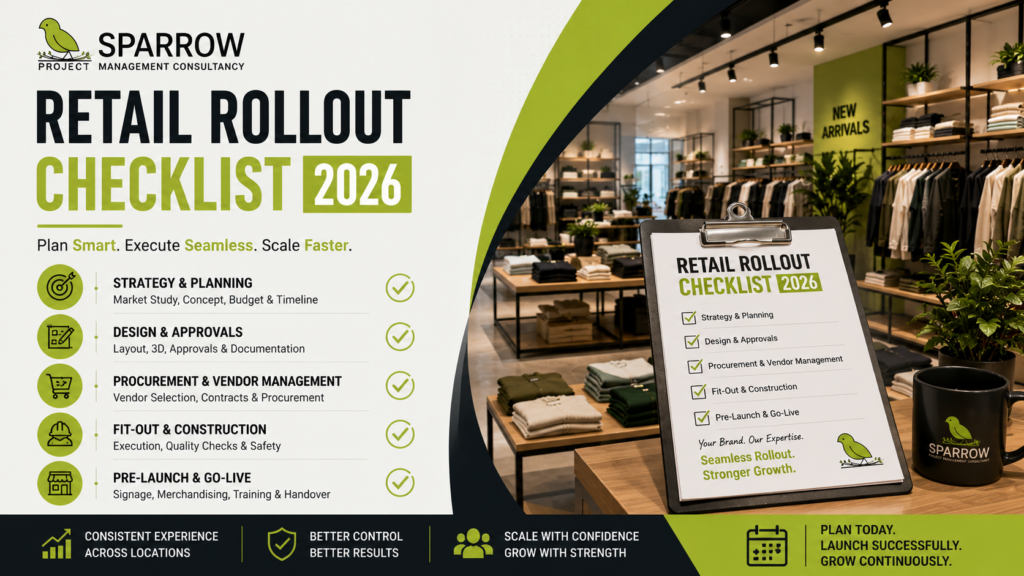
Opening one retail store requires careful planning. Rolling out multiple stores across different cities requires an organised system for controlling design, budgets, approvals, procurement, execution, quality, and opening dates. A missing drawing, delayed approval, incomplete BOQ, unavailable material, or late fixture delivery can affect the entire rollout schedule. Without central coordination, brands may also face inconsistent finishes, cost variations, repeated mistakes, and different customer experiences across locations. This Retail Rollout Checklist 2026 provides a practical framework for retail brands, franchise operators, project teams, developers, and business owners planning new store openings in India. Quick Answer A successful retail rollout requires every store to pass through eight controlled stages: Each activity should have a responsible owner, deadline, approval status, and supporting document. Retail Rollout Checklist at a Glance Rollout Stage Key Deliverable Recommended Status Programme planning Store-wise rollout plan Approved Site assessment Technical survey report Completed Design Coordinated GFC drawings Approved Budgeting BOQ and project budget Frozen Approvals Landlord and statutory clearances Received Procurement Material and fixture tracker Active Execution Detailed site schedule Active Quality Inspection and snag reports Closed Handover Handover documents Submitted Opening Launch-readiness approval Confirmed 1. Retail Rollout Planning Checklist Before beginning work at individual locations, the brand should prepare an overall rollout strategy. Business Planning Programme Management The programme schedule should show which stores are under survey, design, approval, procurement, execution, snagging, and handover. 2. Site Selection and Assessment Checklist A commercially attractive property may not always be technically suitable for the proposed store. Commercial Site Review Technical Site Survey A technical feasibility report should be completed before the lease is finalised wherever possible. 3. Design Checklist Retail design must support customer experience, merchandising, operations, safety, and repeatability across locations. Design Brief Required Drawings Design Coordination GFC means Good for Construction. Work should begin only after the relevant drawings have been reviewed and formally approved. 4. Budget and BOQ Checklist The rollout budget should be based on measurable scope rather than a general per-square-foot assumption. Budget Planning BOQ Review Vendor Commercial Evaluation Selecting a vendor only on the lowest quotation can create additional claims later when the original scope is incomplete. 5. Approval Checklist Approval requirements differ between malls, high-street properties, airports, commercial complexes, and standalone buildings. Landlord or Mall Approvals Internal Brand Approvals Every approval should be recorded with its submission date, reviewer, current status, comments, and closure date. 6. Procurement and Fixture Checklist Late procurement is one of the most common causes of delayed store openings. Procurement Planning Typical Long-Lead Items Fixture Production For multi-store rollouts, store-wise labelling and dispatch control help prevent fixtures from reaching the wrong location. 7. Site Execution Checklist Execution should follow an approved sequence supported by daily reporting and milestone reviews. Before Site Start During Execution Critical Execution Activities Concealed electrical, plumbing, HVAC, and fire services should be inspected before ceilings or wall finishes are closed. 8. Quality-Control Checklist Quality should be inspected throughout execution instead of being checked only before opening. Interior Quality Checks MEP Quality Checks Fixture and Branding Checks 9. Snagging and Handover Checklist Construction completion does not automatically mean the store is ready to open. Snagging Testing and Commissioning Handover Documentation 10. Store Opening Readiness Checklist The store opening date should be confirmed only after construction, operations, merchandise, and compliance teams are aligned. Operational Readiness Launch Readiness A short buffer between construction handover and the public opening helps the operations team complete merchandising, testing, and staff preparation. Multi-Store Rollout Dashboard A central dashboard should track every location through the complete rollout cycle. Store Design Approval Procurement Execution Snagging Opening Location A Approved Received In progress Active Pending Planned Location B In progress Pending Not started Not started Pending Planned Location C Approved Received Completed Completed Closed Ready Recommended dashboard fields include: Common Retail Rollout Mistakes How PMC Supports Retail Rollouts A retail Project Management Consultancy creates a central control system across all locations. PMC support may include: The objective is to identify risks early, maintain consistency, and give management reliable visibility across the complete rollout programme. FAQs What is a retail rollout checklist? A retail rollout checklist is a structured list of activities required to open one or multiple stores. It covers site assessment, design, budgeting, approvals, procurement, execution, quality, handover, and opening readiness. How long does a retail store rollout take? A standard retail rollout usually takes approximately 6 to 14 weeks. Small and standardised stores may open faster, while large, premium, or technically complex stores may require 12 to 20 weeks or more. What should be completed before fit-out begins? Site possession, measurements, GFC drawings, BOQ, budget approval, vendor appointment, execution schedule, landlord permissions, and long-lead procurement planning should be substantially complete before work begins. How can brands manage multiple store openings? Brands should use standard drawings, common BOQ formats, approved material libraries, modular fixtures, central dashboards, store-wise schedules, approved vendors, and consistent quality checklists. What are the biggest retail rollout risks? The most common risks include incomplete drawings, delayed approvals, late decisions, missing BOQ scope, long-lead procurement, vendor capacity issues, unexpected site conditions, and weak progress tracking. Why is a technical site survey important? A technical survey identifies site dimensions, electrical capacity, HVAC provisions, fire systems, structural restrictions, access conditions, and landlord requirements. It helps prevent design errors, additional costs, and execution delays. When should a PMC be appointed? A PMC should ideally be appointed during the early planning or site-assessment stage. Early involvement improves budgeting, design coordination, approval planning, vendor selection, and schedule control. Conclusion The Retail Rollout Checklist 2026 helps brands manage store expansion through a clear and repeatable process. A successful rollout depends on more than fast construction. It requires accurate site information, coordinated drawings, realistic budgets, timely approvals, disciplined procurement, capable vendors, continuous quality checks, and proper opening preparation. Retail brands using standard processes and central project controls can open stores faster, maintain consistent quality, reduce cost variations, and gain better visibility across multiple locations. Planning a Retail Rollout in 2026? Sparrow PMC provides end-to-end project management consultancy
PMC vs Turnkey Contractor: Which Is Better?
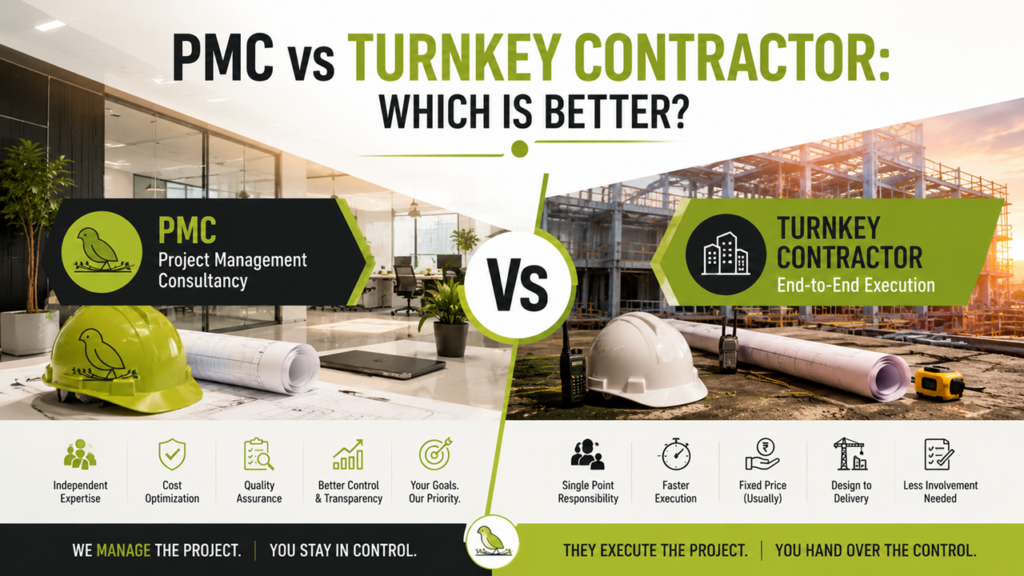
When planning an office, retail store, restaurant, salon, spa, or commercial fit-out, one of the first decisions is how the project will be managed. Should you appoint a Project Management Consultancy and hire contractors separately? Or should you give the complete responsibility to a turnkey contractor? Both models can deliver successful projects, but they work differently. A PMC gives the client greater visibility and independent control, while a turnkey contractor provides a single point of responsibility for design, procurement, and execution. The right choice depends on project complexity, budget, internal capabilities, timeline, quality expectations, and how much involvement the client wants. Quick Answer A PMC is usually better when the client wants independent cost control, transparent vendor management, quality monitoring, and greater decision-making authority. A turnkey contractor is often better when the client wants one company to manage the complete project with minimal internal coordination. Complex or high-value projects may benefit from combining both models. What Is a Project Management Consultancy? A Project Management Consultancy, or PMC, represents the client and manages the project on the client’s behalf. The PMC may coordinate: Its responsibility is to ensure the project moves according to the approved scope, budget, timeline, and quality standards. The PMC generally does not perform all construction work itself. Instead, it independently monitors the consultants, contractors, and vendors responsible for execution. Typical PMC Responsibilities What Is a Turnkey Contractor? A turnkey contractor takes responsibility for delivering a completed, ready-to-use project under one contract. Depending on the agreement, the contractor may manage: The client gives the project brief, approves important decisions, and receives the completed space at the end. The term “turnkey” means the client should be able to take possession and begin operations with minimal additional coordination. Typical Turnkey Contractor Responsibilities PMC vs Turnkey Contractor: Key Differences Factor PMC Model Turnkey Model Client representative PMC acts independently for the client Contractor represents its own delivery responsibility Number of contracts Multiple vendors may be appointed separately Usually one main contract Cost transparency Generally higher Depends on contractor’s commercial structure Client control High Moderate Coordination responsibility Managed by PMC Managed by turnkey contractor Execution responsibility Individual contractors Single turnkey contractor Design flexibility Greater flexibility Changes may affect agreed cost and timeline Vendor selection Client can approve each vendor Contractor usually selects subcontractors Internal effort required More client decisions may be needed Lower day-to-day client involvement Accountability Shared across PMC and vendors Primarily with one contractor Best suited for Complex, high-value or control-sensitive projects Fast, clearly defined or standardised projects Advantages of Hiring a PMC Independent Project Control A PMC works as the client’s representative. Its role is to question delays, verify quality, review bills, and protect the project’s commercial interests. This creates an independent layer between the client and the execution vendors. Better Cost Visibility The client can see the cost of individual work packages, contractor rates, approved changes, and actual progress. This is useful when cost transparency is a priority. Flexibility in Vendor Selection The client can appoint specialists for different work packages rather than depending on one company for every activity. For example, separate vendors may be selected for: Stronger Quality Monitoring Because the PMC is not responsible for earning a margin from every execution package, it can inspect work more independently. Better for Complex Projects A PMC model works well when a project has multiple stakeholders, technical services, specialised vendors, or strict brand standards. Limitations of the PMC Model A PMC model may involve more contracts, approvals, and client decisions. Potential limitations include: These risks can be reduced through a clear responsibility matrix, strong contracts, and a disciplined project schedule. Advantages of a Turnkey Contractor Single Point of Responsibility The client coordinates primarily with one company. This simplifies communication and reduces the need to manage multiple vendors directly. Faster Decision-Making Design, procurement, and execution teams may work under the same organisation, allowing decisions to move faster. Easier Commercial Management The client generally deals with one quotation, one work order, and one payment structure. Useful for Repeatable Projects Turnkey delivery can work well for standardised retail stores, franchise outlets, branch offices, clinics, cafés, or rollout projects where design and specifications are already defined. Lower Internal Coordination Requirement Businesses without an in-house project team may prefer turnkey delivery because the contractor manages most site-level coordination. Limitations of the Turnkey Model The main concern in turnkey delivery is that the same company controls both execution and much of the reporting. Potential risks include: A detailed scope, BOQ, material specification, payment schedule, and quality checklist are essential before awarding a turnkey contract. Which Model Offers Better Cost Control? PMC generally offers better cost transparency because vendors can quote separately and bills can be independently reviewed. However, a turnkey contract can provide better initial price certainty when the scope is fully defined and the agreement is genuinely fixed-price. The key distinction is: A turnkey price may increase if the design changes, the scope is incomplete, or exclusions were not understood before the work order was issued. Which Model Is Faster? Turnkey delivery can be faster when: PMC-managed projects can also be fast, especially when the consultant coordinates design, approvals, procurement, and execution in parallel. Project speed depends more on planning quality and decision-making than on the delivery model alone. Which Model Provides Better Quality? Neither model automatically guarantees better quality. Quality depends on: PMC provides independent quality monitoring. A capable turnkey contractor may provide consistent quality through integrated teams, but the client should still establish clear inspection and approval processes. When Should You Choose a PMC? A PMC model may be more suitable when: Corporate offices, premium retail stores, large restaurants, experience centres, and multi-location programmes often benefit from professional PMC support. When Should You Choose a Turnkey Contractor? A turnkey model may be more suitable when: The client should still evaluate the contractor’s team, financial capacity, previous work, subcontractors, quality controls, and project schedule. Can PMC and Turnkey Work Together? Yes. A hybrid model can combine the advantages of both approaches.
How Long Does a Retail Store Rollout Take?
A typical retail store rollout takes approximately 6 to 14 weeks from initial site planning to final handover. Small kiosks and simple outlets may be completed in 3 to 6 weeks, while large, premium, or technically complex stores may require 12 to 20 weeks or more. The actual duration depends on store size, design readiness, site condition, landlord approvals, material availability, fixture production, vendor capacity, and the speed of business decisions. For retail brands, the rollout timeline is not just a construction schedule. It affects rent, inventory planning, staff recruitment, marketing campaigns, franchise commitments, and expected sales. A delay in one activity can affect the entire store opening plan. Quick Answer A standard retail store rollout usually takes 6 to 14 weeks. Planning and design may require 2 to 4 weeks, approvals 1 to 3 weeks, fit-out execution 3 to 8 weeks, and snagging and handover another 3 to 7 days. Complex stores may take longer. Retail Store Rollout Timeline at a Glance Store Format Typical Rollout Duration Small kiosk 3–5 weeks Basic high-street shop 4–7 weeks Standard branded retail store 6–10 weeks Mall-based retail store 8–14 weeks Premium or luxury store 12–20 weeks Large-format store 14–24 weeks Store renovation or refresh 2–6 weeks These timelines are indicative. The project may take longer when design, approvals, or procurement are incomplete before execution starts. Main Stages of a Retail Store Rollout A store rollout should be managed through clear phases rather than treated as one continuous construction activity. 1. Site Assessment and Project Brief Typical duration: 2 to 5 days The first stage is to understand the location and define what the store needs. This includes: A proper site assessment helps identify technical and commercial risks before the design is finalized. 2. Design Development and Coordination Typical duration: 1 to 3 weeks The design stage includes layout planning, customer flow, fixtures, lighting, signage, storage, services, and visual merchandising requirements. Drawings may include: The design should be coordinated with the actual site before work begins. Starting execution with incomplete drawings often creates rework and delays. 3. BOQ, Budget and Vendor Finalization Typical duration: 5 to 12 days Once the design is sufficiently clear, the Bill of Quantities should be prepared or reviewed. This stage includes: A low quotation does not always mean a lower final cost. Missing scope items may later appear as additional claims. 4. Mall, Landlord and Internal Approvals Typical duration: 1 to 3 weeks Approvals may run in parallel with design and vendor finalization. Common approvals include: Mall-based stores often require more coordination because work timings, access, debris removal, and approved service systems are controlled by the mall management. 5. Procurement and Fixture Production Typical duration: 2 to 6 weeks Procurement should begin as soon as specifications are approved. Long-lead items can determine the store opening date. Common long-lead items include: Fixture manufacturing should be tracked separately from site execution. A store may be physically ready but unable to open because display units have not arrived. 6. Site Fit-Out Execution Typical duration: 3 to 8 weeks The fit-out stage usually includes: Work must happen in the right sequence. Poor sequencing can lead to damage, rework, and contractor overlap. 7. Snagging, Testing and Handover Typical duration: 3 to 7 days Before the store is handed over, all work should be checked against approved drawings and quality standards. This stage includes: Snagging should begin during execution rather than only in the final week. 8. Visual Merchandising and Opening Readiness Typical duration: 1 to 3 days After construction handover, the retail operations team may need time for: The construction completion date and customer opening date should not be treated as the same milestone. What Can Delay a Retail Store Rollout? Incomplete Drawings When drawings continue changing after execution begins, vendors cannot plan their work properly. This causes rework, procurement delays, and extra costs. Late Business Decisions Delays in approving materials, finishes, signage, vendors, or budgets can affect multiple activities. Mall or Landlord Approvals Missing documents, non-compliant drawings, or delayed submissions can stop work before it starts. Long-Lead Materials Fixtures, lighting, glass, signage, and special finishes should be ordered early. Late procurement can delay the entire opening. Poor Vendor Coordination Civil, MEP, furniture, signage, and IT vendors depend on each other. If they are not coordinated, one delayed activity affects the next. Unexpected Site Conditions Hidden services, uneven floors, water leakage, inadequate electrical load, or incomplete landlord work can create additional scope. Design Changes During Execution Changes after procurement or fabrication has started can affect both cost and schedule. Weak Progress Tracking Without daily and weekly tracking, delays may become visible only when recovery is difficult. How to Complete a Retail Store Rollout Faster Speed should come from preparation, not from rushing unfinished work. Freeze the Design Before Site Start Complete major design decisions and coordinate services before execution begins. Identify Long-Lead Items Early Prepare a procurement schedule for fixtures, lighting, signage, glass, hardware, and equipment. Run Activities in Parallel Approvals, procurement, and vendor onboarding can often run alongside design coordination when properly managed. Create a Decision Tracker Every pending decision should have an owner and deadline. Use Standard Store Details Retail brands opening multiple locations should standardize: Monitor Critical Activities Daily Not every activity requires daily escalation. Focus on tasks that directly affect the opening date. Timeline for Multi-Store Rollouts A multi-store rollout should not be calculated by multiplying one store’s timeline by the total number of stores. For example, if one store takes eight weeks, ten stores do not necessarily take eighty weeks. Multiple sites can progress simultaneously through overlapping schedules. A structured rollout may include: The total program duration depends on the number of project teams, fixture production capacity, approved vendors, and the brand’s decision-making process. Retail Rollout Timeline Checklist Before confirming a store opening date, check whether: A buffer of a few days between handover and public opening can reduce unnecessary launch risk. How Project Management Consultancy Helps A retail project management consultant creates one coordinated system for
Retail Store Fit-Out Cost in India: 2026 Guide

The retail store fit-out cost in India generally ranges from ₹1,500 to more than ₹7,000 per sq. ft. in 2026. The final cost depends on the store category, city, site condition, material specifications, furniture quantity, MEP requirements, facade design, technology, and expected quality. A small value-fashion outlet and a premium jewellery showroom cannot be budgeted at the same rate. Even stores of similar size may have very different costs because of custom fixtures, lighting, HVAC, security, flooring, signage, and landlord requirements. This guide provides practical planning ranges for retail brands, franchise owners, developers, and business owners preparing a new store budget. Quick Answer In 2026, a basic retail store fit-out in India may cost approximately ₹1,500–₹2,500 per sq. ft. A standard branded store may require ₹2,500–₹4,500 per sq. ft., while premium stores can cost ₹4,500–₹7,000 per sq. ft. Luxury formats, jewellery stores, and technology-heavy experience centres may exceed ₹7,000 per sq. ft. These are initial budgeting ranges, not contractor quotations. A detailed BOQ and site assessment are required before approving the final project budget. Retail Fit-Out Cost per Square Foot in India Store Category Indicative 2026 Cost Basic shop or economical outlet ₹1,500–₹2,500 per sq. ft. Standard branded retail store ₹2,500–₹4,500 per sq. ft. Premium retail store ₹4,500–₹7,000 per sq. ft. Luxury or highly customised store ₹7,000–₹12,000+ per sq. ft. Minor renovation or refresh ₹700–₹1,800 per sq. ft. These ranges typically cover interior execution, services, finishes, lighting, and fixtures to the extent defined in the project scope. They may not include rent, inventory, security deposits, GST, major equipment, professional fees, statutory charges, or landlord deposits. Estimated Budget by Store Size Store Size Basic Fit-Out Standard Branded Fit-Out Premium Fit-Out 500 sq. ft. ₹7.5–₹12.5 lakh ₹12.5–₹22.5 lakh ₹22.5–₹35 lakh 1,000 sq. ft. ₹15–₹25 lakh ₹25–₹45 lakh ₹45–₹70 lakh 2,000 sq. ft. ₹30–₹50 lakh ₹50–₹90 lakh ₹90 lakh–₹1.4 crore 5,000 sq. ft. ₹75 lakh–₹1.25 crore ₹1.25–₹2.25 crore ₹2.25–₹3.5 crore Larger stores do not always cost proportionately more. Certain fixed expenses, such as electrical panels, signage development, approvals, and mobilisation, may be distributed across a larger area. However, extensive merchandising fixtures can increase the total significantly. What Is Included in a Retail Store Fit-Out? A retail fit-out converts a vacant or partially finished property into an operational, customer-ready store. Civil and Interior Works This may include: Depending on the selected finish, civil and interior works may account for approximately 20%–30% of the fit-out budget. Retail Fixtures and Furniture Fixtures are often one of the largest cost components. They may include: Fixture costs depend on material, finish, modularity, quantity, and whether manufacturing is local or centralised. Electrical and Lighting Retail lighting affects product presentation, customer comfort, and energy consumption. This scope may include: A jewellery or cosmetics store usually needs more specialised lighting than a value-fashion or convenience outlet. HVAC, Fire Safety and Plumbing These services may include: Costs increase when the existing site infrastructure is inadequate or when the landlord provides only a bare-shell space. Facade, Branding and Signage The storefront creates the first customer impression. The cost may include: Premium facade materials, large-format signage, digital screens, and complex structural framing can increase the budget considerably. IT, Security and Retail Technology Modern stores may require: Technology costs should be included early rather than treated as a last-minute addition. Factors That Affect Retail Fit-Out Cost Store Category Jewellery, cosmetics, electronics, fashion, furniture, food retail, and luxury stores have different security, lighting, display, and material requirements. City and Location Costs can be higher in Mumbai, Delhi NCR, Bengaluru, and other major business markets because of labour rates, logistics, working-hour restrictions, and vendor availability. Mall projects may also require deposits, permits, night work, debris charges, safety compliance, and approved contractors. Site Condition A warm-shell site with usable HVAC, flooring, fire systems, and electrical infrastructure may cost less than a bare-shell unit. Renovating an existing store can also become expensive if demolition, disposal, repair, or service replacement is required. Material Specifications Laminate, veneer, metal, stone, glass, acrylic, solid surface, premium hardware, and imported finishes have very different price points. A material should be evaluated not only for appearance but also for durability, maintenance, replacement, and rollout availability. Project Timeline Fast-track execution may require additional labour, parallel working, express transportation, extended shifts, and quicker decision-making. An unrealistic opening date can increase both cost and risk. Number of Stores Multi-store programmes may reduce unit cost through standardised drawings, bulk procurement, modular fixtures, rate contracts, and repeat vendors. However, savings are achieved only when specifications and project controls remain consistent. Costs Commonly Excluded from Fit-Out Estimates Business owners should confirm whether the following items are included: Missing exclusions are a common reason why the approved budget differs from the final project cost. How Long Does a Retail Fit-Out Take? Project Type Typical Execution Period Small shop or kiosk 15–30 days Standard store up to 1,500 sq. ft. 30–50 days Medium branded store 45–75 days Large or premium store 60–120 days Multi-store rollout Managed through overlapping schedules These periods usually begin after drawings, BOQ, vendors, materials, and approvals are substantially ready. Design development and landlord approvals may require additional time. How to Prepare an Accurate Retail Fit-Out Budget Begin With a Site Survey Confirm dimensions, existing services, electrical load, fire systems, HVAC availability, access restrictions, and landlord conditions. Prepare Coordinated Drawings Interior, electrical, HVAC, fire, plumbing, signage, and fixture drawings should agree with each other before construction begins. Develop a Detailed BOQ The BOQ should define quantities, materials, specifications, finishes, brands, inclusions, exclusions, and measurement rules. Compare Vendors on Equal Scope A lower quotation may simply exclude work included by another contractor. Prepare a like-for-like comparison before selection. Add Contingency A contingency of approximately 5%–10% is generally sensible for design changes, site conditions, quantity variations, and minor unforeseen requirements. Track Changes Before Approval Every change should show its cost and timeline impact. Verbal instructions frequently become disputed extras. Common Retail Fit-Out Budgeting Mistakes A low initial budget is not useful if it produces repeated variations during execution. A realistic budget