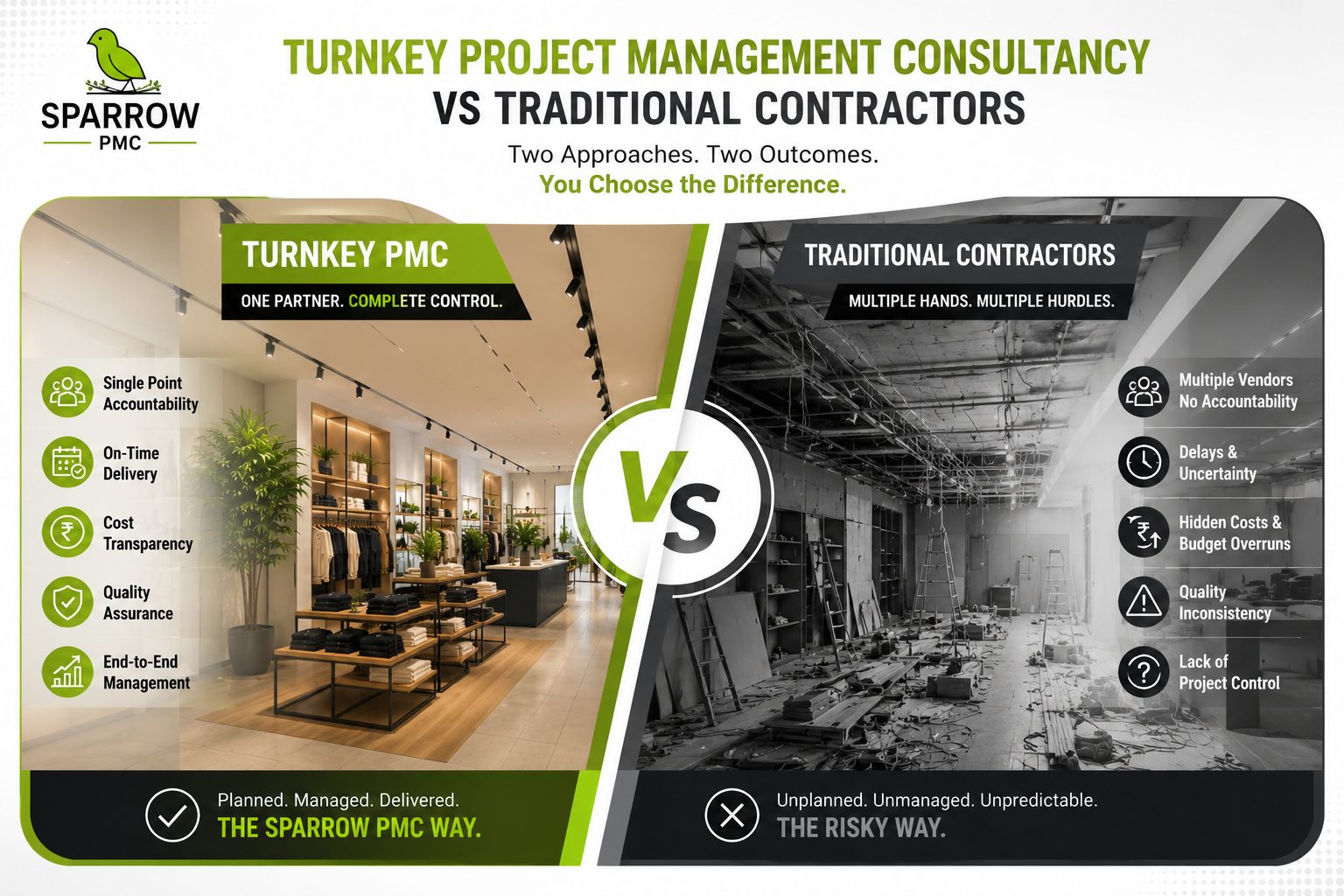
Turnkey Project Management Consultancy vs Traditional Contractors
When planning a commercial project, retail store, office interior, restaurant, salon, spa, showroom, or franchise outlet, one of the most important decisions is choosing the right delivery model.
Many businesses depend only on traditional contractors for execution. Others prefer a more structured approach through turnkey project management consultancy, where planning, coordination, cost control, quality checks, vendor management, and handover are managed professionally from start to finish.
Both models can work, but they are not the same. A traditional contractor mainly focuses on executing the assigned work. A turnkey project management consultancy focuses on managing the complete project outcome.
Understanding the difference helps businesses reduce delays, avoid cost overruns, improve quality, and complete projects with better control.
Quick Answer
Traditional contractors execute specific construction or fit-out work such as civil, interior, electrical, HVAC, plumbing, furniture, or finishing. Turnkey project management consultancy provides end-to-end project control, including planning, design coordination, BOQ review, vendor coordination, timeline tracking, cost monitoring, quality inspection, snag closure, and handover support. For complex commercial projects, a turnkey PMC approach provides better visibility and accountability.
What Is a Traditional Contractor?
A traditional contractor is appointed to execute a defined scope of work.
This may include:
- Civil work
- Interior fit-out
- Electrical work
- HVAC work
- Plumbing
- Fire safety work
- Furniture installation
- Flooring
- Ceiling
- Painting
- Signage
- Finishing work
The contractor’s responsibility is usually limited to the work mentioned in the work order or BOQ. If the scope is unclear, the contractor may raise extra claims or delay work until decisions are finalized.
Traditional contractors are important because they physically execute the project. However, they may not always manage the complete project lifecycle.
What Is Turnkey Project Management Consultancy?
Turnkey project management consultancy is a structured project management approach where the client receives end-to-end support from planning to final handover.
A turnkey PMC may manage:
- Project brief and planning
- Site survey
- Design coordination
- BOQ review
- Cost planning
- Vendor coordination
- Procurement tracking
- Timeline management
- Approval follow-up
- Site execution monitoring
- Quality inspections
- Change order tracking
- Billing review
- Risk management
- Snagging
- Testing and commissioning
- Handover documentation
The focus is not only on completing construction work. The focus is on delivering the project as per approved time, cost, quality, and business requirements.
Key Difference Between Turnkey PMC and Traditional Contractors
| Factor | Turnkey Project Management Consultancy | Traditional Contractor |
|---|---|---|
| Main role | Manages the complete project lifecycle | Executes assigned work |
| Client support | Acts as project control partner | Acts as execution vendor |
| Scope | Planning to handover | Work-order based |
| Cost control | Tracks budget, variations, billing, and changes | Quotes and bills for execution scope |
| Timeline control | Monitors full project schedule | Manages own work schedule |
| Vendor coordination | Coordinates multiple vendors | Coordinates mainly internal team/subcontractors |
| Quality control | Independently monitors quality | Responsible for own workmanship |
| Reporting | Provides structured progress reports | May provide limited site updates |
| Risk management | Identifies risks early | Reacts to execution issues |
| Handover | Tracks snag closure and readiness | Hands over completed scope |
| Best suited for | Complex, multi-vendor, commercial projects | Clearly defined execution packages |
Why Traditional Contractor-Only Projects Face Problems
Contractor-only projects can work when the project is small, simple, and clearly defined. However, commercial projects often involve multiple dependencies.
Common problems include:
- Incomplete drawings before execution
- Poor coordination between vendors
- Delayed material decisions
- Budget variation due to unclear scope
- Limited reporting
- Weak quality checks
- Contractor disputes
- Delayed approvals
- No single view of project progress
- Snag closure delays
A contractor may complete their part, but the overall project can still remain delayed because other activities are not aligned.
Why Turnkey Project Management Consultancy Gives Better Control
1. Better Planning Before Execution
A turnkey PMC reviews the project before site work begins.
This includes:
- Site condition review
- Scope finalization
- Drawing coordination
- BOQ checking
- Budget validation
- Vendor planning
- Timeline preparation
- Risk identification
Strong pre-execution planning reduces confusion during site work.
2. Complete Project Visibility
Clients need to know what is happening on site, what is delayed, who is responsible, and what decisions are pending.
A PMC provides structured reporting on:
- Work progress
- Vendor status
- Material status
- Delays
- Risks
- Pending approvals
- Quality observations
- Next actions
This helps the client take faster and better decisions.
3. Stronger Cost Control
A traditional contractor may quote only for their scope. If the BOQ is incomplete, extra items can increase the project cost.
A turnkey PMC helps control cost through:
- BOQ review
- Vendor comparison
- Scope clarity
- Change order tracking
- Billing verification
- Quantity checks
- Extra item approval
- Budget monitoring
This reduces surprise cost escalation.
4. Vendor Coordination
Commercial projects usually involve multiple vendors. Civil, electrical, HVAC, plumbing, fire safety, furniture, signage, IT, and branding teams must work in sequence.
Turnkey PMC ensures that vendors are aligned with the project schedule and dependencies are tracked properly.
5. Quality Monitoring
Traditional contractors are responsible for their own work quality, but the client still needs independent checks.
A PMC monitors:
- Material quality
- Workmanship
- Drawing compliance
- Finishing standards
- MEP coordination
- Fixture installation
- Snag closure
- Final handover readiness
This creates an additional layer of quality control.
6. Timeline Discipline
Commercial projects are often linked to business deadlines. Delay affects rent, launch date, staff deployment, inventory, marketing, and revenue.
A turnkey PMC tracks the complete project timeline, not only one contractor’s activity.
7. Better Handover
A project is not complete when construction work stops. It is complete when the space is ready for business use.
PMC handover support includes:
- Snag list preparation
- Snag closure tracking
- Testing and commissioning
- Final cleaning check
- Documentation review
- Operational readiness check
- Handover report
This helps avoid incomplete handovers.
When Traditional Contractors Are Suitable
Traditional contractors may be suitable when:
- The project is small
- The scope is very clear
- Drawings are complete
- Only one trade is involved
- The client has an internal project team
- The timeline is flexible
- The client can manage coordination directly
- Cost and quality risks are limited
For example, repainting, small repair works, minor renovation, or isolated civil work may not need full PMC involvement.
When Turnkey PMC Is Better
Turnkey project management consultancy is better when:
- The project has multiple vendors
- Timeline is critical
- Budget control is important
- Quality standards are strict
- The client does not have an internal project team
- The project is in a mall, commercial building, or controlled site
- Approvals are required
- The business opening date is fixed
- Multiple stores or offices are being rolled out
- Senior management needs clear reporting
Retail stores, office interiors, restaurants, cafés, salons, spas, showrooms, and franchise outlets usually benefit from professional PMC support.
Cost Comparison: PMC vs Contractor
A traditional contractor may appear cheaper initially because the client pays only for execution work. However, the final project cost can increase due to:
- Missing scope items
- Extra claims
- Rework
- Delays
- Poor quality
- Material wastage
- Billing disputes
- Lack of planning
A turnkey PMC has a professional fee, but it helps protect the overall project investment.
The better comparison is not “PMC fee vs contractor cost.” The better comparison is:
Total project cost with control vs total project cost without control.
A good PMC can help reduce avoidable losses by improving planning, coordination, billing checks, and quality management.
Timeline Comparison
A contractor may complete their work quickly if everything is ready. But if drawings, approvals, materials, or decisions are delayed, work slows down.
A turnkey PMC helps improve project speed by:
- Preparing a complete schedule
- Tracking approvals
- Monitoring procurement
- Coordinating vendors
- Escalating delays
- Managing dependencies
- Tracking critical activities
- Planning snagging early
Project speed comes from coordination, not only labour deployment.
Quality Comparison
Quality does not depend only on who executes the work. It depends on how clearly specifications are defined and how regularly work is inspected.
Traditional contractor-only projects may face quality gaps when:
- Specifications are unclear
- Site supervision is weak
- Material samples are not approved
- Work is rushed
- Snagging starts too late
A turnkey PMC improves quality control through planned inspections, reporting, and correction tracking.
Common Mistakes Clients Make
Businesses should avoid:
- Choosing only the lowest contractor quote
- Starting work without complete drawings
- Not reviewing BOQ properly
- Ignoring MEP coordination
- Not tracking extra items
- Depending only on verbal updates
- Approving bills without measurement checks
- Delaying material decisions
- Starting snagging only at the end
- Taking handover without testing
These mistakes are common in contractor-only projects and can be reduced with professional project management.
How Sparrow PMC Helps Commercial Projects
Sparrow PMC provides project management consultancy for retail stores, offices, restaurants, F&B outlets, salons, spas, and other commercial projects.
Sparrow PMC supports clients with:
- Project planning
- Site survey coordination
- Design and drawing coordination
- BOQ and budget review
- Vendor coordination
- Timeline tracking
- Cost monitoring
- Quality inspections
- Progress reporting
- Billing review
- Risk management
- Snag closure
- Final handover support
The goal is to help clients complete projects with better control over time, cost, quality, and execution.
FAQs
What is the difference between turnkey PMC and traditional contractors?
A traditional contractor executes assigned work, while turnkey PMC manages the complete project process from planning to handover. PMC focuses on coordination, cost, timeline, quality, reporting, risk, and handover control.
Is turnkey project management consultancy more expensive?
Turnkey PMC includes a professional fee, but it can help reduce rework, delays, billing disputes, quality issues, and uncontrolled variations. The total project cost should be evaluated, not only the PMC fee.
Do I still need contractors if I hire a PMC?
Yes. Contractors are still needed to execute the work. The PMC coordinates, monitors, and manages the project on behalf of the client.
Which is better for retail store fit-outs?
For retail store fit-outs, turnkey PMC is often better when timeline, brand standards, vendor coordination, and launch readiness are important. Contractor-only execution may work for small, simple, clearly defined stores.
Can a PMC manage my existing contractor?
Yes. A PMC can work with existing contractors and vendors, provided scope, drawings, timelines, reporting, and quality expectations are clearly defined.
Why do commercial projects need PMC support?
Commercial projects need PMC support because delays, cost overruns, poor quality, and weak coordination can affect business operations, rent, launch plans, and revenue.
When should PMC be appointed?
PMC should be appointed before execution begins. Early involvement helps with planning, BOQ review, vendor selection, approvals, procurement, and risk control.
Conclusion
Traditional contractors are important for execution, but they may not provide complete project control. Turnkey project management consultancy gives businesses a structured system to manage planning, vendors, cost, timeline, quality, risks, reporting, and handover.
For simple works, a traditional contractor may be enough. For commercial projects where business deadlines, cost control, quality, and accountability matter, a turnkey PMC approach provides stronger control and better project visibility.
The right decision should be based on project complexity, risk, timeline, and the level of control the client needs.
Planning a Commercial Project?
Sparrow PMC provides project management consultancy for retail stores, office interiors, restaurants, F&B outlets, salons, spas, franchise outlets, and multi-location commercial projects.
Contact Sparrow PMC for project planning, BOQ review, vendor coordination, execution monitoring, quality inspection, cost tracking, and handover support.