
When planning an office, retail store, restaurant, salon, spa, or commercial fit-out, one of the first decisions is how the project will be managed.
Should you appoint a Project Management Consultancy and hire contractors separately? Or should you give the complete responsibility to a turnkey contractor?
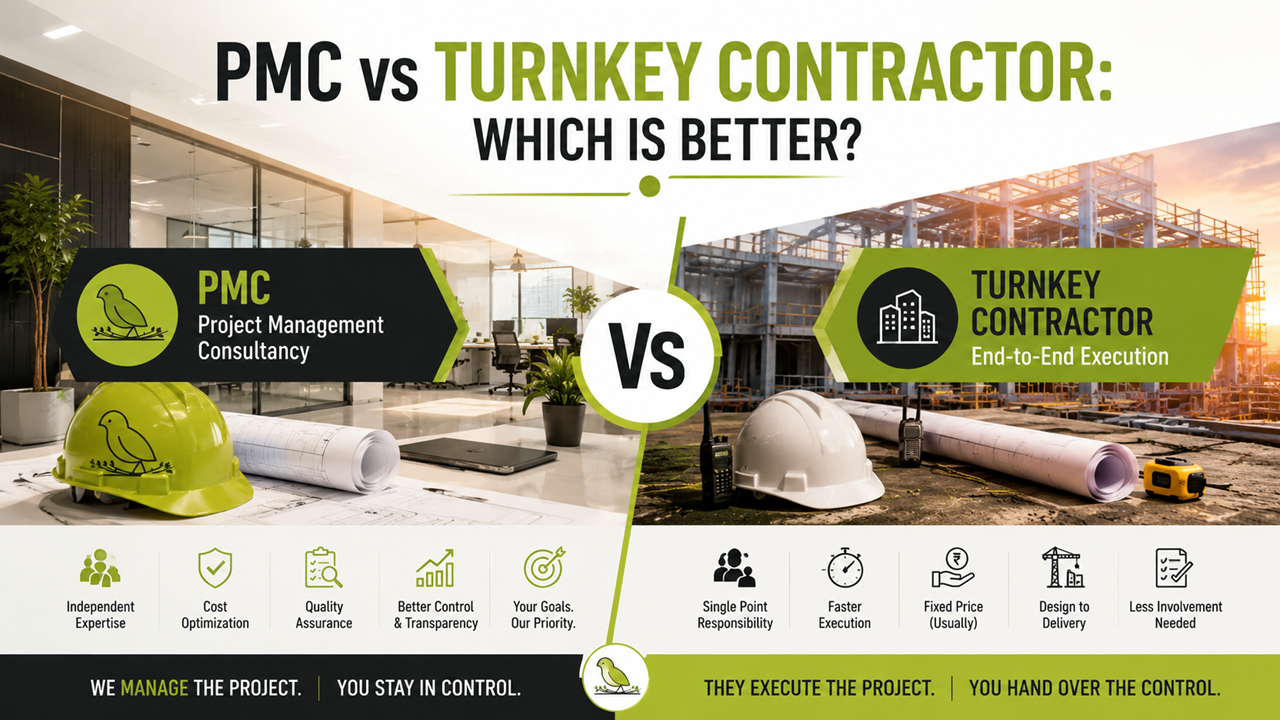
Both models can deliver successful projects, but they work differently. A PMC gives the client greater visibility and independent control, while a turnkey contractor provides a single point of responsibility for design, procurement, and execution.
The right choice depends on project complexity, budget, internal capabilities, timeline, quality expectations, and how much involvement the client wants.
Quick Answer
A PMC is usually better when the client wants independent cost control, transparent vendor management, quality monitoring, and greater decision-making authority. A turnkey contractor is often better when the client wants one company to manage the complete project with minimal internal coordination. Complex or high-value projects may benefit from combining both models.
What Is a Project Management Consultancy?
A Project Management Consultancy, or PMC, represents the client and manages the project on the client’s behalf.
The PMC may coordinate:
- Architects and designers
- Civil contractors
- MEP vendors
- Furniture suppliers
- Signage teams
- Technology vendors
- Landlords and mall teams
- Client stakeholders
Its responsibility is to ensure the project moves according to the approved scope, budget, timeline, and quality standards.
The PMC generally does not perform all construction work itself. Instead, it independently monitors the consultants, contractors, and vendors responsible for execution.
Typical PMC Responsibilities
- Project planning
- Design coordination
- BOQ review
- Tender and vendor comparison
- Budget monitoring
- Schedule management
- Site progress tracking
- Quality inspections
- Change control
- Billing verification
- Risk management
- Snag closure and handover
What Is a Turnkey Contractor?
A turnkey contractor takes responsibility for delivering a completed, ready-to-use project under one contract.
Depending on the agreement, the contractor may manage:
- Design
- Engineering
- Material procurement
- Vendor appointments
- Civil and interior work
- MEP services
- Furniture
- Testing
- Handover
The client gives the project brief, approves important decisions, and receives the completed space at the end.
The term “turnkey” means the client should be able to take possession and begin operations with minimal additional coordination.
Typical Turnkey Contractor Responsibilities
- Translating the brief into a design
- Preparing the project cost
- Procuring materials
- Appointing subcontractors
- Managing site execution
- Coordinating services
- Controlling its internal vendors
- Completing testing and handover
PMC vs Turnkey Contractor: Key Differences
| Factor | PMC Model | Turnkey Model |
|---|---|---|
| Client representative | PMC acts independently for the client | Contractor represents its own delivery responsibility |
| Number of contracts | Multiple vendors may be appointed separately | Usually one main contract |
| Cost transparency | Generally higher | Depends on contractor’s commercial structure |
| Client control | High | Moderate |
| Coordination responsibility | Managed by PMC | Managed by turnkey contractor |
| Execution responsibility | Individual contractors | Single turnkey contractor |
| Design flexibility | Greater flexibility | Changes may affect agreed cost and timeline |
| Vendor selection | Client can approve each vendor | Contractor usually selects subcontractors |
| Internal effort required | More client decisions may be needed | Lower day-to-day client involvement |
| Accountability | Shared across PMC and vendors | Primarily with one contractor |
| Best suited for | Complex, high-value or control-sensitive projects | Fast, clearly defined or standardised projects |
Advantages of Hiring a PMC
Independent Project Control
A PMC works as the client’s representative. Its role is to question delays, verify quality, review bills, and protect the project’s commercial interests.
This creates an independent layer between the client and the execution vendors.
Better Cost Visibility
The client can see the cost of individual work packages, contractor rates, approved changes, and actual progress.
This is useful when cost transparency is a priority.
Flexibility in Vendor Selection
The client can appoint specialists for different work packages rather than depending on one company for every activity.
For example, separate vendors may be selected for:
- Civil work
- HVAC
- Electrical systems
- Furniture
- Signage
- Security
- Specialist finishes
Stronger Quality Monitoring
Because the PMC is not responsible for earning a margin from every execution package, it can inspect work more independently.
Better for Complex Projects
A PMC model works well when a project has multiple stakeholders, technical services, specialised vendors, or strict brand standards.
Limitations of the PMC Model
A PMC model may involve more contracts, approvals, and client decisions.
Potential limitations include:
- Multiple vendor agreements
- More commercial documentation
- Greater need for timely client approvals
- Shared responsibility between different parties
- Possible coordination gaps if the PMC’s authority is unclear
These risks can be reduced through a clear responsibility matrix, strong contracts, and a disciplined project schedule.
Advantages of a Turnkey Contractor
Single Point of Responsibility
The client coordinates primarily with one company. This simplifies communication and reduces the need to manage multiple vendors directly.
Faster Decision-Making
Design, procurement, and execution teams may work under the same organisation, allowing decisions to move faster.
Easier Commercial Management
The client generally deals with one quotation, one work order, and one payment structure.
Useful for Repeatable Projects
Turnkey delivery can work well for standardised retail stores, franchise outlets, branch offices, clinics, cafés, or rollout projects where design and specifications are already defined.
Lower Internal Coordination Requirement
Businesses without an in-house project team may prefer turnkey delivery because the contractor manages most site-level coordination.
Limitations of the Turnkey Model
The main concern in turnkey delivery is that the same company controls both execution and much of the reporting.
Potential risks include:
- Limited visibility into subcontractor pricing
- Reduced control over vendor selection
- Material substitutions
- Variation claims for scope changes
- Quality compromises if specifications are unclear
- Dependence on one contractor’s financial and operational capacity
A detailed scope, BOQ, material specification, payment schedule, and quality checklist are essential before awarding a turnkey contract.
Which Model Offers Better Cost Control?
PMC generally offers better cost transparency because vendors can quote separately and bills can be independently reviewed.
However, a turnkey contract can provide better initial price certainty when the scope is fully defined and the agreement is genuinely fixed-price.
The key distinction is:
- PMC offers visibility and ongoing cost control.
- Turnkey offers consolidated pricing and commercial simplicity.
A turnkey price may increase if the design changes, the scope is incomplete, or exclusions were not understood before the work order was issued.
Which Model Is Faster?
Turnkey delivery can be faster when:
- The project brief is clear
- The design is standardised
- The contractor has strong internal resources
- Materials are readily available
- Client changes are limited
PMC-managed projects can also be fast, especially when the consultant coordinates design, approvals, procurement, and execution in parallel.
Project speed depends more on planning quality and decision-making than on the delivery model alone.
Which Model Provides Better Quality?
Neither model automatically guarantees better quality.
Quality depends on:
- Complete drawings
- Clear specifications
- Approved material samples
- Skilled labour
- Site supervision
- Inspection systems
- Mock-up approvals
- Snag closure discipline
PMC provides independent quality monitoring. A capable turnkey contractor may provide consistent quality through integrated teams, but the client should still establish clear inspection and approval processes.
When Should You Choose a PMC?
A PMC model may be more suitable when:
- The project is large or technically complex
- Cost transparency is important
- Multiple specialist vendors are required
- The client wants control over vendor selection
- Design quality must be closely protected
- The project has several stakeholders
- Independent billing and quality checks are required
- Multiple projects must be tracked through one system
Corporate offices, premium retail stores, large restaurants, experience centres, and multi-location programmes often benefit from professional PMC support.
When Should You Choose a Turnkey Contractor?
A turnkey model may be more suitable when:
- The project scope is clearly defined
- The client wants one point of accountability
- Internal project-management resources are limited
- The project is small or medium-sized
- The design is standardised
- Speed and convenience are priorities
- The contractor has proven experience in the project category
The client should still evaluate the contractor’s team, financial capacity, previous work, subcontractors, quality controls, and project schedule.
Can PMC and Turnkey Work Together?
Yes. A hybrid model can combine the advantages of both approaches.
The client appoints a turnkey contractor for complete execution and a PMC to independently monitor:
- Scope compliance
- Project schedule
- Material quality
- Site progress
- Change orders
- Contractor billing
- Testing
- Snag closure
- Final handover
This creates single-point execution responsibility while preserving independent client-side control.
The hybrid model can be useful for high-value projects where the client wants turnkey convenience without losing visibility.
Questions to Ask Before Choosing
Questions for a PMC
- What similar projects have you managed?
- How will you control cost and timeline?
- How frequently will you report progress?
- Will you verify contractor bills?
- How will you manage design changes?
- What support will you provide during handover?
Questions for a Turnkey Contractor
- What exactly is included and excluded?
- Is the price fixed or subject to measurement?
- Which materials and brands are specified?
- Who will manage the site?
- Which works will be subcontracted?
- How will delays and variations be handled?
- What warranties will be provided?
Common Mistakes to Avoid
- Choosing a model only on the lowest fee
- Starting without complete drawings
- Accepting an unclear BOQ
- Not documenting exclusions
- Allowing verbal scope changes
- Making payments without progress verification
- Ignoring contractor capacity
- Not defining quality standards
- Leaving approvals until execution
- Taking handover without testing and snag closure
The delivery model cannot protect a poorly defined project. Clear documentation remains essential in both approaches.
FAQs
Is PMC more expensive than a turnkey contractor?
PMC creates a separate consultancy fee, but it may reduce rework, billing errors, delays, and uncontrolled variations. The total project cost should be evaluated rather than comparing only the PMC fee with the contractor’s margin.
Is a turnkey contract always fixed-price?
No. A turnkey contract is fixed-price only when the agreement clearly states it and the scope is complete. Changes, exclusions, quantity variations, and unforeseen site conditions may still affect the final cost.
Who is responsible for delays in the PMC model?
Responsibility depends on the cause. A contractor may be responsible for poor execution, the designer for delayed drawings, the vendor for late materials, or the client for pending decisions. The PMC tracks these responsibilities and supports recovery planning.
Can a PMC appoint contractors?
A PMC can help prepare tender documents, compare quotations, review capabilities, and recommend contractors. The final appointment is normally approved by the client.
Which model is better for retail rollouts?
Turnkey delivery can work well for standardised stores, while PMC support is valuable for independent control across multiple locations. Many brands use a hybrid structure with turnkey contractors managed through a central PMC system.
Which model is better for office interiors?
The answer depends on office size and complexity. A small office with a clear brief may suit turnkey delivery. A large corporate office with complex services, multiple stakeholders, and strict budget controls may benefit from a PMC or hybrid model.
Conclusion
There is no single answer to PMC vs turnkey contractor: which is better?
Choose a PMC when transparency, independent control, specialised vendors, and close quality monitoring are priorities. Choose a turnkey contractor when you need one point of responsibility, simpler coordination, and a clearly defined project delivered with limited internal involvement.
For complex or high-value projects, combining a turnkey contractor with an independent PMC can provide a practical balance of speed, accountability, visibility, and quality control.
The best decision should be based on project risk, not convenience alone.
Planning a Commercial Fit-Out Project?
Sparrow PMC provides project management consultancy for retail stores, commercial offices, restaurants, salons, spas, residential projects, and multi-location expansion programmes.
Contact Sparrow PMC for project planning, cost review, vendor coordination, execution monitoring, quality control, and handover support.