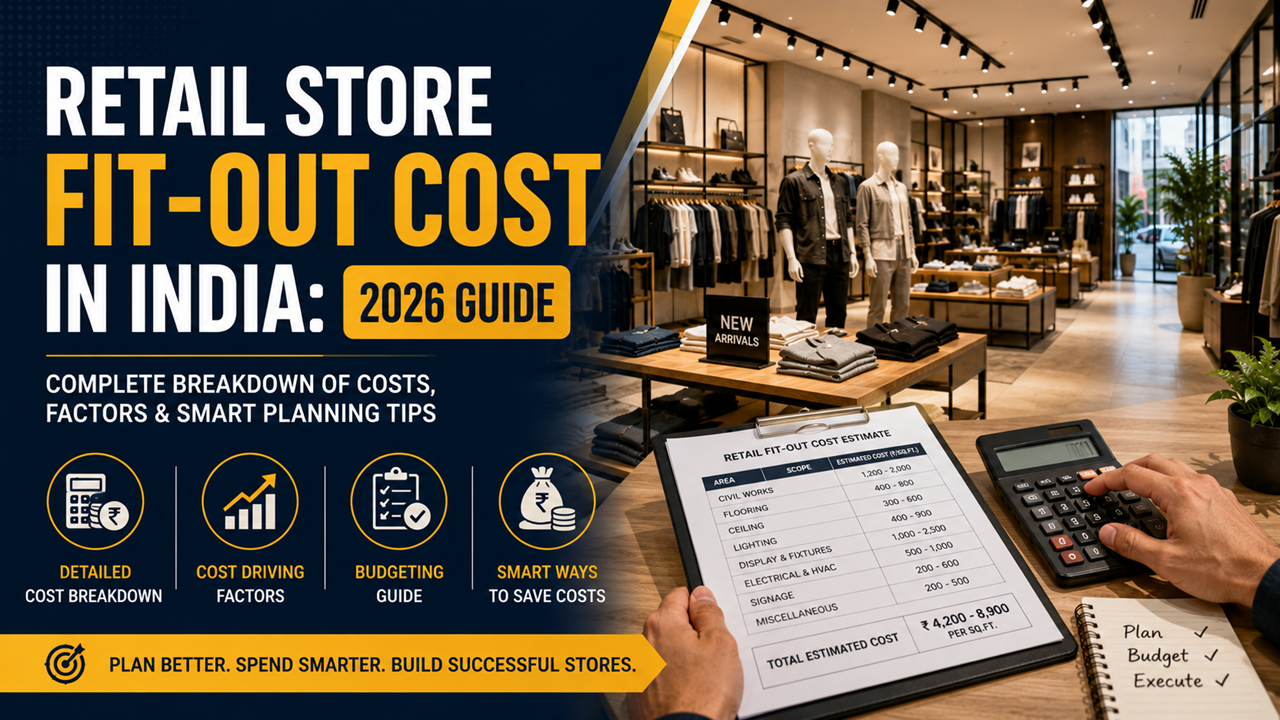
The retail store fit-out cost in India generally ranges from ₹1,500 to more than ₹7,000 per sq. ft. in 2026. The final cost depends on the store category, city, site condition, material specifications, furniture quantity, MEP requirements, facade design, technology, and expected quality.
A small value-fashion outlet and a premium jewellery showroom cannot be budgeted at the same rate. Even stores of similar size may have very different costs because of custom fixtures, lighting, HVAC, security, flooring, signage, and landlord requirements.
This guide provides practical planning ranges for retail brands, franchise owners, developers, and business owners preparing a new store budget.
Quick Answer
In 2026, a basic retail store fit-out in India may cost approximately ₹1,500–₹2,500 per sq. ft. A standard branded store may require ₹2,500–₹4,500 per sq. ft., while premium stores can cost ₹4,500–₹7,000 per sq. ft. Luxury formats, jewellery stores, and technology-heavy experience centres may exceed ₹7,000 per sq. ft.
These are initial budgeting ranges, not contractor quotations. A detailed BOQ and site assessment are required before approving the final project budget.
Retail Fit-Out Cost per Square Foot in India
| Store Category | Indicative 2026 Cost |
|---|---|
| Basic shop or economical outlet | ₹1,500–₹2,500 per sq. ft. |
| Standard branded retail store | ₹2,500–₹4,500 per sq. ft. |
| Premium retail store | ₹4,500–₹7,000 per sq. ft. |
| Luxury or highly customised store | ₹7,000–₹12,000+ per sq. ft. |
| Minor renovation or refresh | ₹700–₹1,800 per sq. ft. |
These ranges typically cover interior execution, services, finishes, lighting, and fixtures to the extent defined in the project scope. They may not include rent, inventory, security deposits, GST, major equipment, professional fees, statutory charges, or landlord deposits.
Estimated Budget by Store Size
| Store Size | Basic Fit-Out | Standard Branded Fit-Out | Premium Fit-Out |
| 500 sq. ft. | ₹7.5–₹12.5 lakh | ₹12.5–₹22.5 lakh | ₹22.5–₹35 lakh |
| 1,000 sq. ft. | ₹15–₹25 lakh | ₹25–₹45 lakh | ₹45–₹70 lakh |
| 2,000 sq. ft. | ₹30–₹50 lakh | ₹50–₹90 lakh | ₹90 lakh–₹1.4 crore |
| 5,000 sq. ft. | ₹75 lakh–₹1.25 crore | ₹1.25–₹2.25 crore | ₹2.25–₹3.5 crore |
Larger stores do not always cost proportionately more. Certain fixed expenses, such as electrical panels, signage development, approvals, and mobilisation, may be distributed across a larger area. However, extensive merchandising fixtures can increase the total significantly.
What Is Included in a Retail Store Fit-Out?
A retail fit-out converts a vacant or partially finished property into an operational, customer-ready store.
Civil and Interior Works
This may include:
- Partitions and wall construction
- Flooring
- False ceiling
- Wall finishes
- Painting
- Doors and glass partitions
- Trial rooms
- Cash counter construction
- Storage areas
Depending on the selected finish, civil and interior works may account for approximately 20%–30% of the fit-out budget.
Retail Fixtures and Furniture
Fixtures are often one of the largest cost components.
They may include:
- Wall-mounted display systems
- Gondolas and freestanding units
- Shelving
- Product tables
- Cash counters
- Trial-room fixtures
- Storage units
- Custom display furniture
Fixture costs depend on material, finish, modularity, quantity, and whether manufacturing is local or centralised.
Electrical and Lighting
Retail lighting affects product presentation, customer comfort, and energy consumption.
This scope may include:
- Electrical wiring
- Distribution boards
- Track lights and spotlights
- Decorative lighting
- Emergency lights
- Power points
- Lighting controls
- Earthing and testing
A jewellery or cosmetics store usually needs more specialised lighting than a value-fashion or convenience outlet.
HVAC, Fire Safety and Plumbing
These services may include:
- Air-conditioning modifications
- Fresh-air requirements
- Fire alarm and sprinkler relocation
- Plumbing and drainage
- Pantry or wash-area services
- Testing and commissioning
Costs increase when the existing site infrastructure is inadequate or when the landlord provides only a bare-shell space.
Facade, Branding and Signage
The storefront creates the first customer impression.
The cost may include:
- Shopfront glazing
- Entrance framing
- Illuminated signage
- ACP, metal, stone or laminate cladding
- Window displays
- Internal branding
- Wayfinding graphics
Premium facade materials, large-format signage, digital screens, and complex structural framing can increase the budget considerably.
IT, Security and Retail Technology
Modern stores may require:
- CCTV
- Access control
- Data cabling
- Wi-Fi
- POS infrastructure
- Electronic article surveillance
- Footfall counters
- Digital displays
- Music systems
Technology costs should be included early rather than treated as a last-minute addition.
Factors That Affect Retail Fit-Out Cost
Store Category
Jewellery, cosmetics, electronics, fashion, furniture, food retail, and luxury stores have different security, lighting, display, and material requirements.
City and Location
Costs can be higher in Mumbai, Delhi NCR, Bengaluru, and other major business markets because of labour rates, logistics, working-hour restrictions, and vendor availability.
Mall projects may also require deposits, permits, night work, debris charges, safety compliance, and approved contractors.
Site Condition
A warm-shell site with usable HVAC, flooring, fire systems, and electrical infrastructure may cost less than a bare-shell unit.
Renovating an existing store can also become expensive if demolition, disposal, repair, or service replacement is required.
Material Specifications
Laminate, veneer, metal, stone, glass, acrylic, solid surface, premium hardware, and imported finishes have very different price points.
A material should be evaluated not only for appearance but also for durability, maintenance, replacement, and rollout availability.
Project Timeline
Fast-track execution may require additional labour, parallel working, express transportation, extended shifts, and quicker decision-making. An unrealistic opening date can increase both cost and risk.
Number of Stores
Multi-store programmes may reduce unit cost through standardised drawings, bulk procurement, modular fixtures, rate contracts, and repeat vendors. However, savings are achieved only when specifications and project controls remain consistent.
Costs Commonly Excluded from Fit-Out Estimates
Business owners should confirm whether the following items are included:
- GST
- Rent and security deposit
- Inventory and merchandise
- Design consultancy fees
- PMC fees
- Landlord or mall deposits
- Statutory approvals
- Loose equipment
- Internet and software subscriptions
- Brand launch and marketing
- Visual merchandising stock
- Utility connection charges
- Insurance
- Post-handover maintenance
Missing exclusions are a common reason why the approved budget differs from the final project cost.
How Long Does a Retail Fit-Out Take?
| Project Type | Typical Execution Period |
| Small shop or kiosk | 15–30 days |
| Standard store up to 1,500 sq. ft. | 30–50 days |
| Medium branded store | 45–75 days |
| Large or premium store | 60–120 days |
| Multi-store rollout | Managed through overlapping schedules |
These periods usually begin after drawings, BOQ, vendors, materials, and approvals are substantially ready. Design development and landlord approvals may require additional time.
How to Prepare an Accurate Retail Fit-Out Budget
Begin With a Site Survey
Confirm dimensions, existing services, electrical load, fire systems, HVAC availability, access restrictions, and landlord conditions.
Prepare Coordinated Drawings
Interior, electrical, HVAC, fire, plumbing, signage, and fixture drawings should agree with each other before construction begins.
Develop a Detailed BOQ
The BOQ should define quantities, materials, specifications, finishes, brands, inclusions, exclusions, and measurement rules.
Compare Vendors on Equal Scope
A lower quotation may simply exclude work included by another contractor. Prepare a like-for-like comparison before selection.
Add Contingency
A contingency of approximately 5%–10% is generally sensible for design changes, site conditions, quantity variations, and minor unforeseen requirements.
Track Changes Before Approval
Every change should show its cost and timeline impact. Verbal instructions frequently become disputed extras.
Common Retail Fit-Out Budgeting Mistakes
- Applying one rate to every store category
- Starting work without complete drawings
- Ignoring MEP and fire-safety costs
- Underestimating fixture quantities
- Selecting vendors only on the lowest quote
- Excluding approvals and landlord charges
- Ordering long-lead materials too late
- Making design changes during finishing
- Keeping no contingency
- Approving bills without measurement checks
A low initial budget is not useful if it produces repeated variations during execution. A realistic budget creates better control and faster decisions.
How Project Management Helps Control Fit-Out Cost
A retail project management consultant provides independent visibility across design, procurement, construction, quality, and handover.
PMC support may include:
- Scope and BOQ review
- Budget tracking
- Vendor comparison
- Procurement monitoring
- Progress reporting
- Change control
- Quality inspections
- Billing verification
- Snag management
- Opening-readiness checks
The consultant’s role is not simply to reduce every rate. It is to protect the approved business outcome while preventing avoidable waste, delays, rework, and unplanned expenditure.
FAQs
A standard branded retail store may cost approximately ₹2,500–₹4,500 per sq. ft. in 2026. Basic stores may start near ₹1,500 per sq. ft., while premium and luxury formats may cost ₹4,500–₹12,000 or more, depending on specifications.
It depends on the quotation. Some fit-out estimates include fixed display fixtures and cash counters but exclude loose furniture, equipment, or merchandising accessories. The BOQ should clearly define every included and excluded item.
Mall stores may involve restricted working hours, material-entry procedures, safety compliance, deposits, debris charges, approved service vendors, and complex coordination with mall systems. However, high-street properties can also cost more if the existing infrastructure requires major upgrades.
A contingency of around 5%–10% is generally advisable. The percentage may need to be higher for renovation projects, older properties, incomplete designs, or fast-track work with uncertain quantities.
Yes. Standard drawings, modular fixtures, approved materials, bulk procurement, rate contracts, and repeat vendors can reduce cost and execution time. Savings depend on disciplined specification control and accurate store-level planning.
Conclusion
The retail store fit-out cost in India in 2026 can range from approximately ₹1,500 per sq. ft. for a basic outlet to more than ₹7,000 per sq. ft. for premium and highly customised formats.
The most reliable budget is not based on a single market rate. It is developed from the store format, site condition, coordinated drawings, material specifications, BOQ, vendor capacity, execution period, and opening requirements.
Retail brands should finalise scope early, compare vendors fairly, monitor changes, and maintain a realistic contingency. This approach protects both project investment and the planned store opening date.
Planning a Retail Store or Multi-Store Rollout?
Sparrow PMC provides end-to-end project management consultancy for retail stores, commercial offices, restaurants, salons, spas, and multi-location expansion programmes.
Contact Sparrow PMC for a detailed project assessment, budget review, execution plan, and opening-readiness strategy.