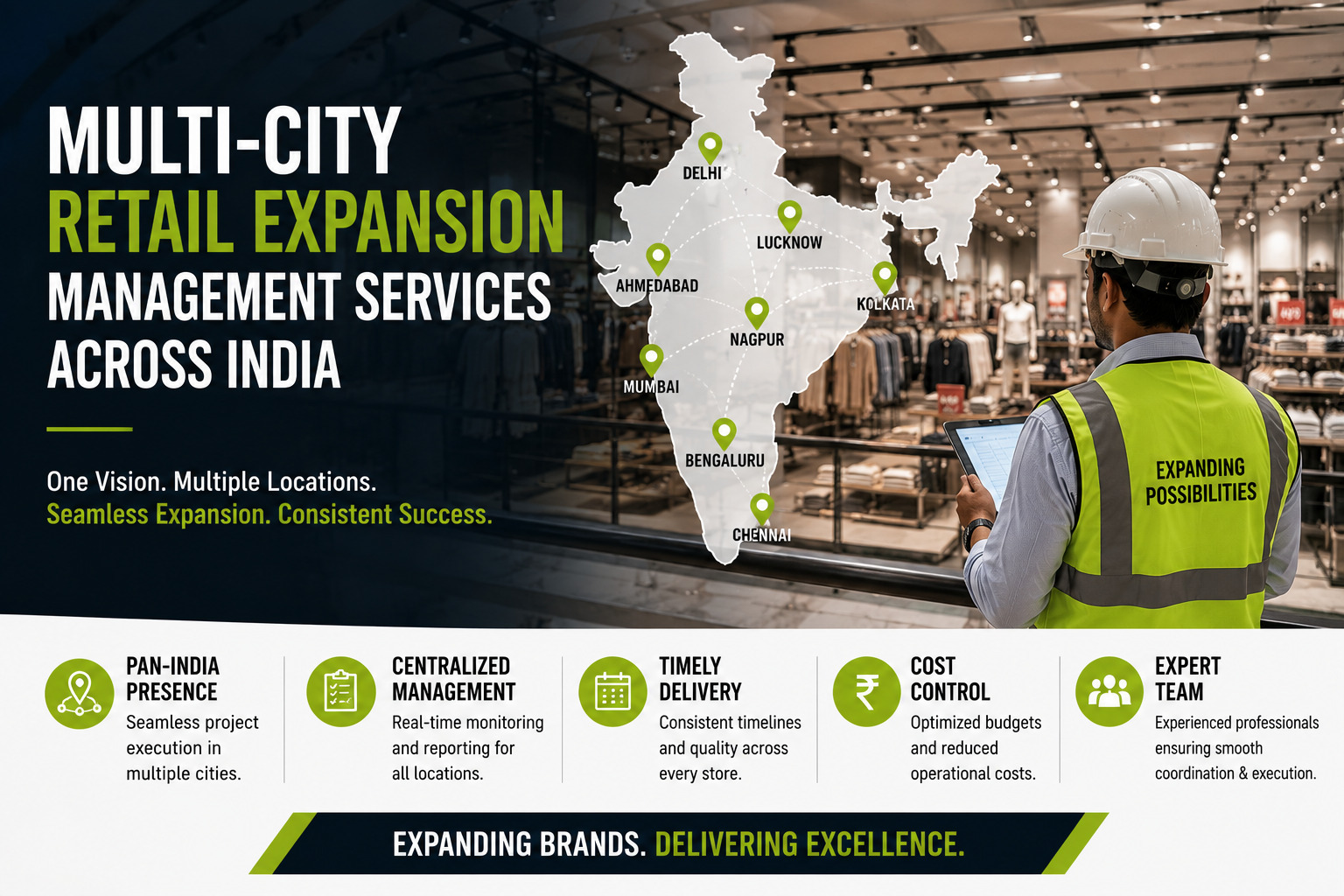
Multi-City Retail Expansion Management Services Across India
Expanding a retail brand across multiple cities in India requires more than opening stores one by one. It requires a structured rollout system that can manage locations, vendors, timelines, budgets, approvals, quality, reporting, and launch readiness across different regions.
A store in Delhi NCR, Mumbai, Bengaluru, Hyderabad, Pune, Chennai, Kolkata, Ahmedabad, Jaipur, Lucknow, or a Tier-2 city may face completely different site conditions, landlord processes, mall rules, vendor availability, material timelines, and execution challenges.
This is why multi-city retail expansion management services are important for growing retail brands. A professional retail PMC helps brands manage expansion with better control, visibility, and consistency across India.
Quick Answer
Multi-city retail expansion management services help brands manage retail store rollouts across different Indian cities through site assessment, rollout planning, design coordination, BOQ review, vendor management, cost tracking, timeline monitoring, quality inspection, snag closure, and store launch readiness. The goal is to open stores faster, more consistently, and with better control.
Why Multi-City Retail Expansion Needs Professional Management
Retail expansion across India involves multiple moving parts. Every location needs coordination between the brand team, landlord, mall management, designer, contractor, fixture vendor, signage team, MEP vendors, IT team, operations team, and local agencies.
Without structured management, brands may face:
- Delayed store openings
- Inconsistent store quality
- Cost variation across cities
- Vendor coordination gaps
- Poor site reporting
- Late fixture delivery
- Approval delays
- MEP coordination issues
- Franchisee confusion
- Brand standard mismatch
- Snag closure delays
- Launch readiness problems
A professional PMC creates one central system to track every store from planning to handover.
What Are Multi-City Retail Expansion Management Services?
Multi-city retail expansion management services cover the complete process of planning, coordinating, monitoring, and controlling multiple retail projects across different locations.
These services may include:
- Store rollout planning
- Site survey coordination
- Technical site assessment
- Design and drawing coordination
- BOQ and budget review
- Vendor finalization support
- Mall and landlord approval tracking
- Procurement monitoring
- Fixture production tracking
- Site execution monitoring
- Quality inspections
- Progress reporting
- Cost control
- Snag closure
- Final handover
- Store opening readiness
The objective is to ensure every store is delivered as per brand expectations, approved budget, and launch timeline.
Key Challenges in Retail Expansion Across India
1. Different Site Conditions
Every property is different. Some stores are bare shell, some are warm shell, and some are renovation sites.
A PMC checks:
- Site measurements
- Electrical load
- HVAC availability
- Fire safety systems
- Plumbing points
- Ceiling height
- Flooring condition
- Access restrictions
- Landlord scope
- Existing services
This helps the brand identify risks before execution begins.
2. Approval Delays
Mall and landlord approvals can delay store execution.
Common approvals include:
- Layout approval
- MEP approval
- Fire safety approval
- Signage approval
- Material movement approval
- Work permit
- Contractor registration
- Safety documentation
- Night work permission
A PMC tracks approvals and escalates pending items early.
3. Vendor Coordination Across Cities
Retail projects involve multiple vendors working together.
These may include:
- Civil contractor
- Interior contractor
- Electrical vendor
- HVAC vendor
- Plumbing vendor
- Fire safety vendor
- Fixture manufacturer
- Signage vendor
- IT and CCTV vendor
- Cleaning vendor
The PMC ensures all vendors work in the correct sequence and follow the approved timeline.
4. Brand Standard Consistency
Customers expect the same brand experience across locations. Store design, lighting, signage, fixtures, flooring, facade, and finishes must remain consistent.
PMC support helps monitor:
- Approved drawings
- Material specifications
- Fixture details
- Lighting standards
- Signage quality
- Storefront execution
- Finishing quality
- Visual readiness
This is critical for retail chains, franchise brands, lifestyle brands, jewellery stores, fashion brands, electronics stores, beauty brands, and F&B outlets.
5. Cost Control Across Locations
Costs can vary by city due to labour rates, material availability, logistics, site condition, and landlord requirements.
A PMC helps control cost through:
- BOQ review
- Vendor comparison
- Rate tracking
- Change order monitoring
- Extra item approval
- Billing verification
- Quantity checks
- Cost variation reporting
This helps the brand maintain better budget discipline across locations.
6. Timeline Control
Retail stores are often linked to rent-free periods, launch campaigns, inventory movement, franchise commitments, and revenue targets.
Timeline tracking includes:
- Site possession date
- Drawing approval date
- Vendor mobilization
- Material procurement
- Fixture delivery
- Civil and MEP progress
- Signage installation
- Snagging
- Handover
- Store opening
A structured tracker helps leadership identify which stores are on track, delayed, or at risk.
Scope of Multi-City Retail Expansion Management
Rollout Planning
Rollout planning defines how many stores will open, in which cities, and within what timeframe.
This includes:
- Expansion calendar
- Store-wise schedule
- City-wise priority
- Vendor allocation
- Reporting format
- Risk tracker
- Launch timeline
- Handover process
A clear rollout plan helps the brand avoid execution confusion.
Site Survey and Assessment
Before execution begins, every site must be technically assessed.
The site assessment checks:
- Actual measurements
- Existing services
- Structural condition
- MEP readiness
- Landlord scope
- Access rules
- Material movement rules
- Site risks
- Fit-out constraints
This prevents wrong assumptions at the planning stage.
Design Coordination
Retail rollout requires complete and coordinated drawings.
This may include:
- Layout plan
- Flooring plan
- Ceiling plan
- Electrical drawings
- Lighting layout
- HVAC coordination
- Fire safety coordination
- Plumbing drawings
- Fixture drawings
- Signage details
- Facade drawings
The PMC helps ensure drawings are ready before execution starts.
BOQ and Budget Review
A clear BOQ reduces disputes and cost variation.
PMC review includes:
- Quantity checking
- Scope clarity
- Rate comparison
- Inclusion and exclusion review
- Location-wise cost tracking
- Extra item monitoring
- Billing verification
This is especially useful when stores are being executed in different cities by different vendors.
Procurement and Fixture Tracking
Retail stores often depend on long-lead items.
These may include:
- Custom fixtures
- Display units
- Cash counters
- Lighting
- Signage
- Glass
- Flooring
- Hardware
- Digital screens
- Security systems
- HVAC equipment
A PMC tracks procurement so stores do not remain incomplete due to missing materials.
Site Execution Monitoring
Site execution monitoring includes:
- Daily or weekly progress review
- Vendor coordination
- Labour deployment check
- Material status
- Quality observations
- Delay reporting
- Issue escalation
- Site photographs
- Next action tracking
This gives the brand real visibility across multiple live locations.
Quality Inspection
Quality inspection helps ensure every store meets approved brand standards.
Checks may include:
- Flooring quality
- Ceiling alignment
- Wall finish
- Paint quality
- Electrical installation
- Lighting alignment
- HVAC installation
- Plumbing work
- Fixture placement
- Signage quality
- Storefront finish
- Final cleaning
Quality checks should happen during execution, not only at handover.
Snagging and Handover
Before handover, all pending issues should be listed and closed.
Handover support includes:
- Snag list preparation
- Snag closure tracking
- Testing and commissioning
- Final quality check
- Fixture inspection
- Lighting check
- Signage check
- Cleaning check
- Handover documentation
- Store readiness confirmation
A store should be handed over only when it is ready for operations.
Benefits of Multi-City Retail Expansion Management
Faster Store Rollouts
Structured planning and tracking help brands open stores with fewer delays.
Better Brand Consistency
Stores across different cities are monitored against approved brand standards.
Improved Cost Control
BOQ review, billing checks, and change tracking reduce uncontrolled variations.
Clear Visibility for Leadership
Management gets store-wise updates, delay alerts, and decision trackers.
Stronger Vendor Accountability
Vendor performance is tracked across each location.
Reduced Internal Pressure
Brand teams can focus on business expansion while the PMC manages project-level execution control.
Better Launch Readiness
Final handover, snag closure, cleaning, signage, systems, and visual readiness are tracked properly.
Multi-City Retail Expansion Dashboard
Brands should maintain a store-wise rollout tracker.
| Store Location | Stage | Key Risk | Action Required |
|---|---|---|---|
| Delhi NCR | Execution | Fixture delay | Vendor follow-up |
| Mumbai | Approval | Signage approval pending | Mall coordination |
| Bengaluru | Procurement | Lighting delivery pending | Procurement tracking |
| Pune | Snagging | Final finishing issues | Snag closure |
| Hyderabad | Handover | Cleaning pending | Final readiness check |
A live dashboard helps leadership understand the exact status of every location.
Retail Expansion Checklist
Before starting multi-city expansion, brands should confirm:
- Expansion calendar is approved
- Store formats are finalized
- Design kit is ready
- BOQ format is standardized
- Vendor responsibilities are clear
- City-wise vendor strategy is defined
- Site survey format is ready
- Approval tracker is active
- Procurement tracker is prepared
- Quality checklist is finalized
- Reporting format is agreed
- Handover process is defined
- Launch readiness buffer is included
This checklist helps convert expansion into a controlled programme.
Common Mistakes in Multi-City Retail Expansion
Starting Without Standard Drawings
Without standard drawings, every store becomes a separate design exercise.
Not Checking Site Conditions Early
Site risks discovered late can delay execution and increase cost.
Using Different BOQ Formats
Different BOQ formats make cost comparison difficult.
Depending Only on Local Vendors
Local vendors may need close monitoring to maintain brand standards.
Ignoring Long-Lead Items
Fixtures, lighting, signage, and equipment must be tracked early.
Weak Reporting
Without structured reporting, leadership gets delayed or incomplete information.
Opening Stores Without Proper Snag Closure
Pending snags can affect customer experience and operational performance.
How Sparrow PMC Supports Multi-City Retail Expansion
Sparrow PMC provides project management consultancy for retail stores, franchise outlets, offices, restaurants, F&B spaces, salons, spas, commercial interiors, and multi-location rollouts.
For multi-city retail expansion, Sparrow PMC supports:
- Rollout planning
- Site survey coordination
- Design coordination
- BOQ and cost review
- Vendor coordination
- Timeline tracking
- Procurement monitoring
- Site execution monitoring
- Quality inspections
- Progress reporting
- Snag closure
- Handover support
- Store launch readiness
Sparrow PMC helps brands manage expansion across India with better visibility, discipline, and execution control.
FAQs
What is multi-city retail expansion management?
Multi-city retail expansion management is the process of planning, coordinating, monitoring, and controlling store rollouts across different cities. It includes site surveys, approvals, vendors, costs, timelines, quality, snagging, and handover.
Why do retail brands need PMC for expansion?
Retail brands need PMC support to maintain timeline control, cost visibility, vendor coordination, quality consistency, reporting, and launch readiness across multiple locations.
How does PMC help in store rollouts?
PMC helps with rollout planning, design coordination, BOQ review, approval tracking, procurement monitoring, site supervision, quality checks, snag closure, and final handover.
Can one PMC manage stores across multiple cities?
Yes. A structured PMC can manage multi-city rollouts through store-wise trackers, regional coordination, vendor monitoring, reporting formats, and site-level supervision.
What is the biggest risk in retail expansion?
The biggest risks are delayed approvals, incomplete drawings, vendor delays, poor site coordination, cost variation, and inconsistent quality across locations.
How can brands reduce rollout delays?
Brands can reduce delays by standardizing drawings, finalizing BOQs early, tracking approvals, ordering long-lead items on time, monitoring vendors, and using a central project reporting system.
When should a PMC be appointed for retail expansion?
A PMC should be appointed before site execution begins. Early involvement helps with planning, site surveys, BOQ review, vendor planning, approval tracking, and risk control.
Conclusion
Multi-city retail expansion across India requires a structured project management system. Every city, site, vendor, landlord, and approval process can create different challenges.
Professional expansion management helps brands maintain control over cost, timeline, quality, vendors, approvals, reporting, snag closure, and store launch readiness.
For retail brands planning to expand across India, a dedicated PMC partner can reduce delays, improve consistency, and make the rollout process more predictable.
Planning Multi-City Retail Expansion?
Sparrow PMC provides project management consultancy for retail stores, franchise outlets, restaurants, offices, salons, spas, and commercial projects across India.
Contact Sparrow PMC for rollout planning, site assessment, BOQ review, vendor coordination, project monitoring, quality inspection, snag closure, and store launch-readiness support.