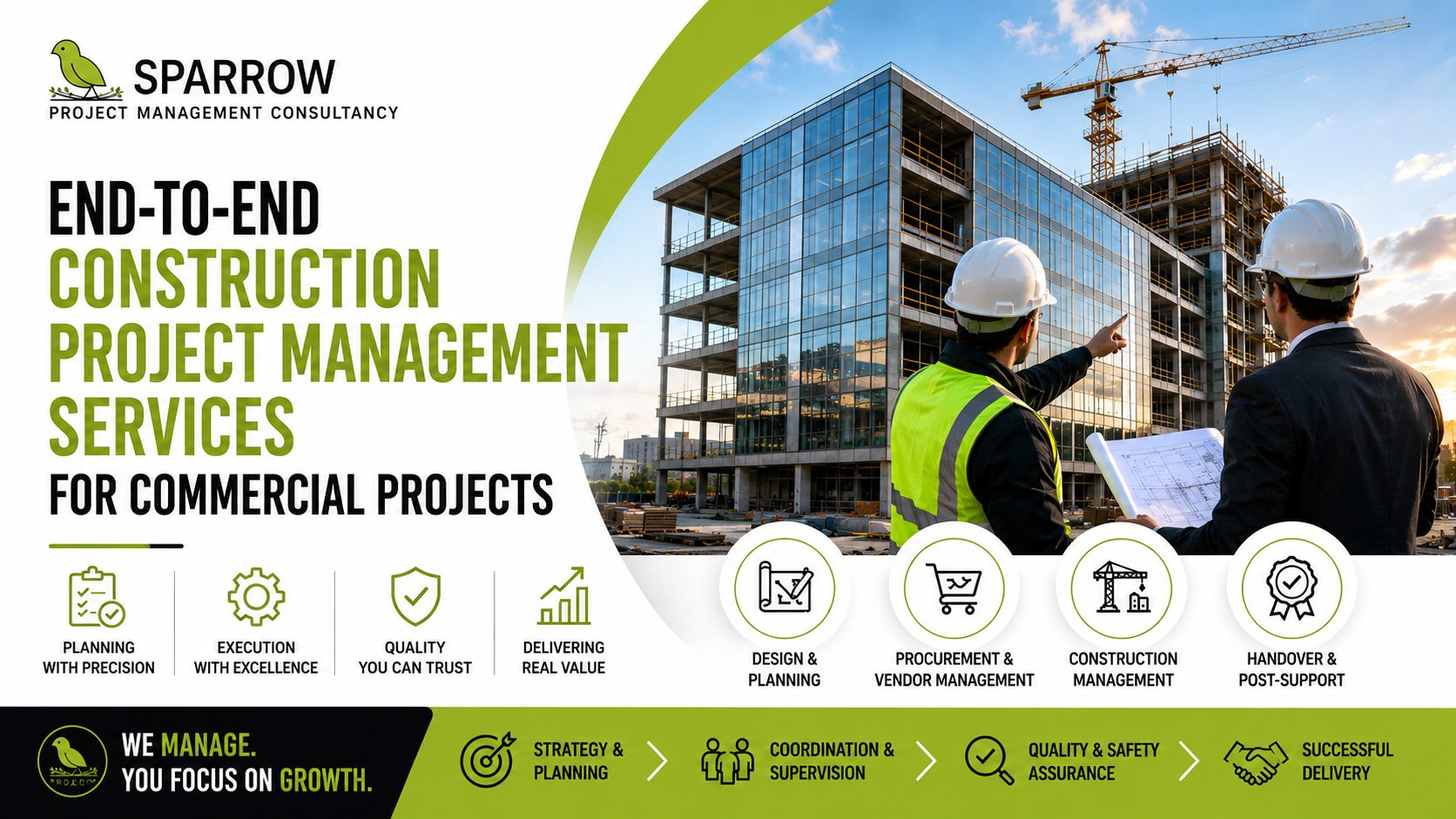
Commercial construction projects require strong planning, disciplined execution, and constant coordination between multiple teams. Whether the project is a retail store, office, restaurant, showroom, salon, spa, warehouse, or commercial interior fit-out, success depends on how well the project is managed from start to finish.
A commercial project is not only about completing civil, interior, electrical, HVAC, plumbing, fire, furniture, and finishing works. It is about delivering a business-ready space within the approved budget, timeline, quality standards, and operational requirements.
This is where end-to-end construction project management services become important. A professional Project Management Consultancy, or PMC, helps clients manage every stage of the project with better control, reporting, and accountability.
Quick Answer
End-to-end construction project management services for commercial projects include planning, design coordination, BOQ review, vendor management, cost control, schedule tracking, site supervision, quality inspection, risk management, snag closure, testing, commissioning, and final handover. The goal is to complete the project on time, within budget, and as per approved quality and business requirements.
What Is End-to-End Construction Project Management?
End-to-end construction project management means managing the complete project lifecycle from the initial brief to final handover.
It covers:
- Project planning
- Site survey
- Design coordination
- BOQ and budget review
- Vendor finalization
- Approval tracking
- Procurement monitoring
- Site execution supervision
- Quality control
- Cost tracking
- Risk management
- Billing verification
- Snag closure
- Testing and commissioning
- Final handover
The PMC works as the client’s project control partner. It coordinates between designers, contractors, vendors, landlords, consultants, and client teams to ensure the project moves in the right direction.
Why Commercial Projects Need Professional Project Management
Commercial projects usually have fixed business deadlines. A retail store may need to open before a marketing campaign. An office may need to be ready before team relocation. A restaurant may need to launch before rent-free period ends. A showroom may need to be operational before a seasonal sales period.
Without proper project management, businesses may face:
- Delays in site execution
- Budget overruns
- Poor vendor coordination
- Incomplete drawings
- Material delivery delays
- Quality defects
- Rework
- Scope confusion
- Billing disputes
- Approval delays
- Weak handover documentation
Professional construction project management reduces these risks by creating a structured system for planning, monitoring, reporting, and decision-making.
Key Stages of End-to-End Construction Project Management
1. Project Brief and Requirement Understanding
The first stage is to understand the business objective behind the project.
This includes:
- Type of commercial project
- Project size and location
- Business opening date
- Budget expectations
- Design intent
- Operational requirements
- Brand standards
- Client priorities
- Risk areas
A clear project brief helps every stakeholder understand what the project must achieve.
2. Site Survey and Existing Condition Review
Before execution begins, the site must be properly studied.
A site survey checks:
- Actual site measurements
- Existing civil condition
- Electrical load availability
- HVAC provision
- Plumbing points
- Fire safety systems
- Ceiling height
- Flooring condition
- Access restrictions
- Landlord or mall guidelines
- Material movement rules
Many project delays happen because site realities are discovered late. A detailed site survey helps identify risks before work starts.
3. Design Coordination
Commercial projects involve multiple drawings and technical inputs.
Design coordination may include:
- Layout drawings
- Flooring plan
- Ceiling plan
- Electrical drawings
- Lighting layout
- HVAC drawings
- Fire safety coordination
- Plumbing drawings
- Furniture and fixture drawings
- Signage and branding drawings
- Material specifications
The PMC ensures that drawings are complete, coordinated, and suitable for execution. Starting work with incomplete drawings often leads to rework, cost variations, and site confusion.
4. BOQ and Budget Review
The Bill of Quantities, or BOQ, is one of the most important project documents. It defines the project scope, quantities, specifications, and commercial basis.
PMC support includes:
- BOQ checking
- Scope review
- Quantity validation
- Rate comparison
- Inclusion and exclusion review
- Cost estimate review
- Budget tracking format
- Change control process
A clear BOQ reduces disputes between the client and vendors. It also helps compare contractor quotations on a fair basis.
5. Vendor and Contractor Finalization
Commercial projects often require multiple vendors.
These may include:
- Civil contractor
- Interior contractor
- Electrical vendor
- HVAC vendor
- Plumbing vendor
- Fire safety vendor
- Furniture supplier
- Signage vendor
- IT and security vendor
- Cleaning and handover support team
The PMC helps review vendor capability, quotations, scope, timelines, and responsibilities before work is awarded.
6. Project Schedule and Timeline Planning
A project schedule converts the scope into a clear execution plan.
The schedule should define:
- Site start date
- Key milestones
- Vendor-wise activities
- Material delivery dates
- Long-lead items
- Inspection stages
- Snagging period
- Handover date
- Launch-readiness buffer
A good schedule is not only a date chart. It shows dependencies between activities so that delays can be identified early.
7. Procurement and Material Tracking
Material delay is one of the most common reasons for commercial project delays.
Procurement tracking includes:
- Approved material list
- Vendor-wise procurement plan
- Long-lead item tracking
- Sample approvals
- Delivery schedules
- Material inspection
- Storage planning
- Replacement planning if delays occur
Important long-lead items may include lights, fixtures, glass, tiles, HVAC equipment, signage, custom furniture, imported finishes, and special hardware.
8. Site Execution Monitoring
During execution, the PMC monitors daily or weekly site progress against the approved plan.
Site monitoring includes:
- Work progress tracking
- Contractor coordination
- Labour deployment review
- Material availability check
- Drawing compliance
- Work sequence management
- Issue escalation
- Delay reporting
- Safety observation
- Client update reporting
This gives the client clear visibility of actual site progress instead of depending only on verbal updates.
9. Quality Control and Inspections
Quality control should happen throughout the project, not only at the end.
PMC quality checks may cover:
- Civil work quality
- Flooring levels and finish
- Ceiling alignment
- Wall finish and paint quality
- Electrical installation
- Lighting alignment
- HVAC installation
- Plumbing work
- Fire safety coordination
- Furniture and fixture installation
- Signage and branding
- Final finishing standards
Regular inspections reduce rework and help maintain the approved quality standard.
10. Cost Control and Change Management
Commercial projects can exceed budget if changes are not controlled.
The PMC tracks:
- Approved budget
- Work order value
- Running bills
- Extra items
- Change requests
- Quantity variations
- Vendor claims
- Pending approvals
- Final billing status
Every change should be documented with cost and timeline impact before approval. This protects the client from surprise cost escalation.
11. Risk Management
Every commercial project has risks. A good PMC identifies risks early and prepares practical action plans.
Common project risks include:
- Late approvals
- Incomplete drawings
- Vendor delays
- Material shortages
- Site restrictions
- Design changes
- Budget overruns
- Poor workmanship
- Safety issues
- Delayed handover
Risk management is not only about reporting problems. It is about preventing them from affecting the final project outcome.
12. Snagging and Handover
A project is not complete until all major snags are closed and the space is ready for use.
Handover support includes:
- Snag list preparation
- Snag closure tracking
- Final quality inspection
- Testing and commissioning
- Electrical checks
- HVAC checks
- Fire safety checks
- Plumbing checks
- Furniture and fixture inspection
- Final cleaning check
- Handover documentation
For commercial projects, the handover must support actual operations, not just physical completion.
Types of Commercial Projects That Need PMC Services
End-to-end construction project management services are useful for:
- Retail stores
- Corporate offices
- Restaurants and cafés
- F&B outlets
- Salons and spas
- Showrooms
- Experience centres
- Clinics
- Training centres
- Warehouses
- Commercial renovations
- Multi-location rollouts
- Franchise outlets
Each project type has different priorities, but all require control over cost, time, quality, vendors, and handover.
Benefits of End-to-End Project Management
Better Timeline Control
A PMC tracks every major project activity and helps prevent avoidable delays.
Cost Visibility
The client gets better clarity on budget, billing, variations, and extra claims.
Strong Vendor Coordination
Multiple vendors are aligned through one project management system.
Improved Quality
Regular inspections help maintain execution quality and reduce rework.
Faster Decision-Making
Pending decisions, risks, and approvals are clearly reported to the client.
Reduced Business Risk
Timely completion protects rent, launch dates, staff planning, inventory, and business operations.
Smooth Handover
The project is checked, tested, cleaned, documented, and handed over in a structured way.
PMC vs Contractor: What Is the Difference?
A contractor executes the work. A PMC manages and monitors the project on behalf of the client.
| Role | Contractor | PMC |
|---|---|---|
| Main responsibility | Execute assigned work | Manage complete project control |
| Works for | Own contract scope | Client’s project interest |
| Focus | Labour, material, execution | Time, cost, quality, scope, risk |
| Reporting | Contractor progress | Independent project status |
| Billing | Raises bills | Reviews and verifies bills |
| Quality | Performs work | Checks and monitors quality |
| Handover | Completes scope | Tracks readiness and snag closure |
Both roles are important. The contractor delivers the work, while the PMC ensures the overall project is delivered properly.
Common Mistakes in Commercial Construction Projects
Businesses should avoid:
- Starting work without complete drawings
- Selecting vendors only on lowest price
- Ignoring MEP coordination
- Not reviewing BOQ properly
- Delaying material approvals
- Depending only on verbal site updates
- Not tracking extra items
- Keeping no contingency
- Starting snagging too late
- Taking handover without testing
Most project problems can be reduced when planning, execution, reporting, and handover are managed professionally.
How Sparrow PMC Supports Commercial Projects
Sparrow PMC provides end-to-end project management consultancy for commercial projects including retail stores, offices, restaurants, F&B outlets, salons, spas, and multi-location rollouts.
Sparrow PMC helps clients with:
- Project planning
- Site assessment
- BOQ and cost review
- Vendor coordination
- Timeline monitoring
- Site execution tracking
- Quality inspections
- Progress reporting
- Billing review
- Snag closure
- Final handover support
The objective is simple: help clients complete commercial projects with better control, fewer delays, stronger quality, and clearer accountability.
FAQs
What are construction project management services?
Construction project management services include planning, coordinating, monitoring, and controlling a construction project from start to finish. They cover cost, timeline, quality, vendors, risks, reporting, and handover.
Why do commercial projects need PMC services?
Commercial projects need PMC services because delays, cost overruns, quality issues, and poor vendor coordination can directly affect business operations, rent, revenue, and launch plans.
When should a PMC be appointed?
A PMC should ideally be appointed before execution begins. Early involvement helps with planning, BOQ review, vendor selection, approval tracking, procurement planning, and risk identification.
Does a PMC replace the contractor?
No. A PMC does not replace the contractor. The contractor executes the work, while the PMC manages project coordination, reporting, quality checks, cost tracking, and handover control on behalf of the client.
What types of commercial projects need end-to-end project management?
Retail stores, offices, restaurants, cafés, salons, spas, showrooms, clinics, franchise outlets, and multi-location rollouts can all benefit from end-to-end project management services.
How does project management help control cost?
Project management helps control cost through BOQ review, vendor comparison, change tracking, billing verification, quantity checks, and approval-based cost monitoring.
What is included in final handover?
Final handover may include snag closure, testing and commissioning, quality inspection, cleaning check, documentation, warranty details, and readiness confirmation for operations.
Conclusion
End-to-end construction project management services are essential for commercial projects that need better control over timelines, costs, quality, vendors, risks, and handover.
A commercial project should not depend only on site execution. It needs structured planning, coordinated drawings, clear BOQ, reliable vendors, material tracking, quality inspections, reporting, and final readiness checks.
For businesses planning retail stores, offices, restaurants, salons, spas, or multi-location rollouts, professional PMC support can reduce delays, improve visibility, control costs, and protect the final business outcome.
Planning a Commercial Project?
Sparrow PMC provides end-to-end construction project management services for retail, office, restaurant, F&B, salon, spa, and commercial fit-out projects.